Security & Compliance
From the endpoint to the edge: Simplifying security in the AI era

Tyler Greenfield
SentinelOne
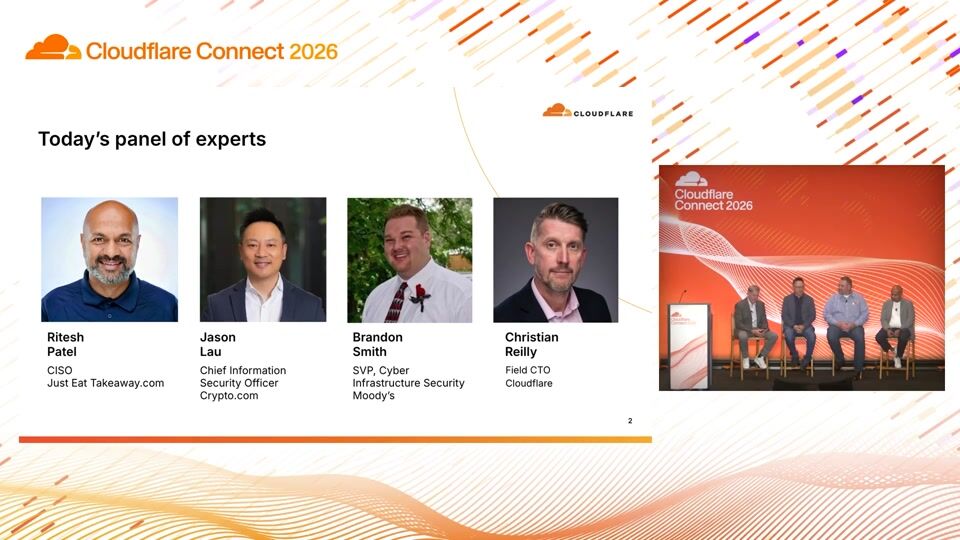
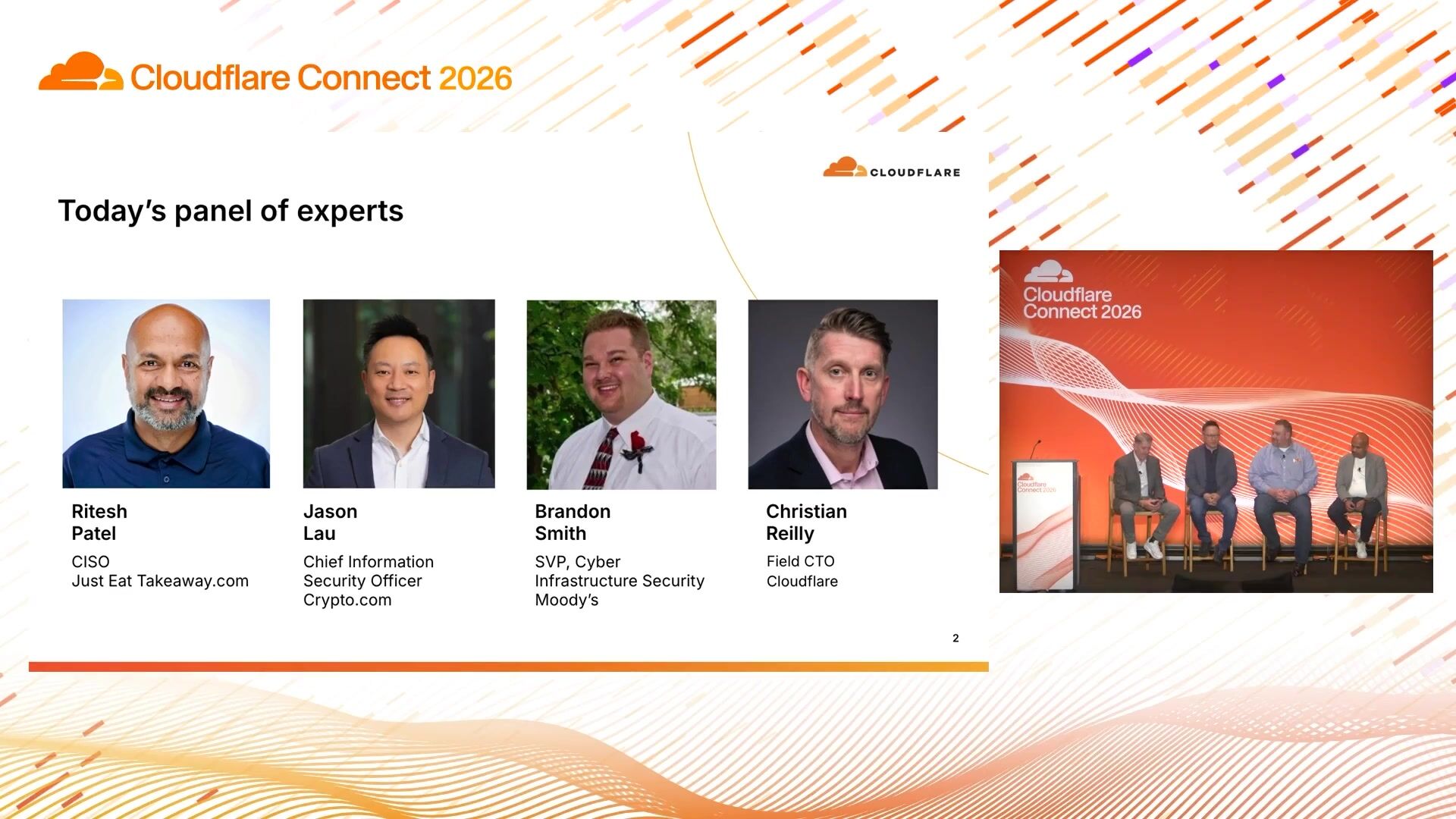
Just Eat Takeaway.com, Crypto.com, and Moody’s bring perspectives shaped by different industries, threat environments, and regions. Their customers, regulatory obligations, pace of change, and tolerance for disruption differ significantly. Yet their security teams face many of the same decisions on how to keep the business moving through this dynamic landscape. This panel explores where their approaches converge, where they diverge, and what each industry can learn from the other.
0:03So first of all, thank you so much for being here. I hope everybody enjoyed the keynote this morning. I'm going to talk about some of the topics from the keynote because I think they're sort of super interesting for the panelists to go through. By the way, I'm Christian. I lead our global field CTO and CISO organization here at Cloudflare. So as well as spending time with these fine panelists, I get to talk to a lot of CISOs and CTOs around the world in many different organizations. so it's a great role to have to learn a lot from what's really going on across the industries and actually pull some very sort of similar themes that we see which we'll discuss a lot today so I'm really pleased to be joined by three of the finest security professionals in the industry I'm going to ask them to introduce themselves and a little bit about their role but please do feel free to to have your questions ready at the end we'd like to use the most we can of these guys time to give you some of their insights and of the challenges that we'll talk through today. So why don't I start with you, Ritz.
0:56Quick introduction and what your role is in the company. Yeah, so I'm CISO for a company called Justy Takeaway. For those of you who don't know it, for anyone in the US, it's equivalent in Europe and the UK to DoorDash, so food delivery. And I look after security as a CISO there. Thank you, Brendan. Thank you for giving us your It's a wedding photo, by the way. It's really nice. Yeah, I don't know where I got that from. Good morning, everyone. My name is Brandon Smith. I'm the Senior Vice President of Cyber Infrastructure Security at Moody's. Been there about six years. We use it as a financial services company globally around the world.
1:42We have kind of a regulated side and an unregulated side, so we're a bank but not a bank kind of deal. So, interesting company. Thank you for having me, Jason. Hi, everyone. uh i'm the group chief information security officer at crypto.com for those of you in the us we've probably seen our logos everywhere uh from sports events uh through a lot of advertising and so forth so my remit is basically everything in security data privacy blockchain security and so forth and uh happy to do some sharing here today absolutely fantastic so three very different industries first of all uh moody's how many years old uh over 100 over 100 yeah so of interesting history or legacy technologies, which we'll get to. Rich just, what, 10, 15 years? 15. Yeah, there or thereabouts, mergers, acquisitions, divestments.
2:29It's our 10th birthday. Happy birthday. Happy birthday at crypto.com. So I'm going to start with something that I think is certainly top of mind in all the conversations that I have with CISOs. And many of you may have seen our own CISO grant talk about this today, which is Cyber Frontier Security. models so i think if we go back a year probably not even a year maybe before mythos um and then post mythos i think what's super interesting is not only has the security landscape changed as a result of that but what's really interesting is that most of the cso's that we engage with have not had access to those cyber frontier models so fortunately we have because we're in the the various programs from anthropic and open ai that give us early access to that and we've learned a lot of really interesting things as grant was explained But what's also happening in the industry is that there's a lot of new models emerging that I think are becoming incredibly capable at things like vulnerability detection, which obviously gives CISOs, I would say, a real headache of how do I understand what's in my own environment?
3:31So we've been talking about software composition analysis and open source dependencies and all those things in the technology stacks that we use. And then there's the production systems challenge. And Grant did a good job of articulating what the potential attack is. might do with these new models so i'm going to ask you first rich so you know when you sort of look at this landscape and you say i need to get understand like what these things are going to do i need to look at my own environment i need to look at all the software i have all the dependencies that i have in that but at the same time i've got a balance like how am i going to patch all those things first of all but then how am i going to think about an architecture that hopefully makes it more difficult for the attackers to potentially use those tools you in a very advanced kind of way. How do you even just sort of step back and think, what have I got to do to make sure that I'm prepared for what these models are gonna bring?
4:24The short answer for me is we can do everything we possibly can.
4:30We're an AI-first company as a whole. And for me, I hold a kind of dual mandate. Number one is to protect the organization.
4:42But also to see how we use AI to protect ourselves and where do we start with that is the key. It's the Frontier models and when Mythos came out, everyone's like, oh, can we have a look at it? Actually, the truth is very shortly afterwards and even to this day now, there's a lot of open models that we can use. People did stop themselves and say, oh, well, you haven't got access to Mythos there. we can't do anything. You could do a lot of this with your own coding and your own LLMs and testing to be able to start finding those gaps. And it's a prioritization game at this point. And for us, reachability was a big part. So, Jason, your view on that obviously is, you know, you look at crypto and you look at companies in the digital native space, and you automatically assume that you guys have got it down is that accurate no that's not accurate so that we it in the crypto space uh it's quite known that the attacks that happen on our industry happen a lot earlier than it triples down to all the other industries so some some even say we see some of the things that are happening maybe even 15 to 18 months earlier uh attacks from nation states and all of these type of crazy things and i completely agree with all you said which is, it's difficult for us to know what these new frontier models are going to do.
6:09So when Mythos, for example, when that came out, there was the Mythos effect where everybody got scared. There's a lot of media hype about it. But at the end of the day, our own internal harnesses of using different models actually was performing just as good as that, finding vulnerabilities and whatnot. And going to your original question with the different models, at the end of the day, many of these models that people are using are large. language models, but there are actually other types of models that many people are not aware of. Some of them are focused on visually, so it was visually looking at the context and so forth. And that was useful for us when we were actually dealing with scams and attacks and so forth, when the attackers were trying to get smarter by not just typing in text, but actually putting images of the text.
6:55So we needed to use a different model to extract that text out of image then run through it then look at the context that there was a scam and so forth so there's a lot of things that we've been trying to evolve with uh and sharing with the broader audience on on you know how to there's not perfect there's not perfect road map it's basically seeing something that looks interesting it's an instant response okay learn from it evolve it and then look for the right model and try and figure it out so it's it's been an interesting ride of the last uh 16-18 months for sure And, Brandon, you know, obviously, financial service is always an attractive asset for the bad guys. How did your thinking change when suddenly there was Mythos Day? And, you know, was it an instant reaction or was it more, hey, we need to figure this out over time?
7:43It's a figure it out thing, right? I mean, all of us are evolving. All of us are trying to understand this, right? So I agree with you. There's a pre -mythos world and a post -mythos world. And how we evolved and how we did things before mythos is quite differently afterwards. You know, we got access to Daybreak, we got access to Glasswing, and we started running that. And we started throwing that at our infrastructure teams. And to your point, it was, what's the prioritization? You got pen testing, you got your vulnerability management team, you got the mythos findings, you got the other people coming out with mythos findings. So having your company understand prioritization and giving that to the business was... the best key to success we had because if not they have 10 000 vulnerabilities they don't know what to prioritize they don't know what to fix and so they just sit there and stare at the number and don't do anything so from a security organization our biggest thing was helping them prioritize helping them to focus on the biggest thing that they could fix to drop their numbers um just one thing i'd add to that it sounds very obvious it really does sound very obvious when you say it out loud and you think about it but doing the basic find out foundational hygiene is not sexy it's not fun it's not cool and nobody's going to thank you for doing it but that's the thing that you need to start doing i i'd spoke to a lot of companies that said right we've got access to mythos so we're going to start going after them okay what about your identity problems yeah your over permissioned applications
9:16your tokens that you haven't um rotated your access token all of these things aren't they're not cool. Mythos was sexy and cool, made cyber cool for a couple of days, you know? But doing your basic cyber hygiene is so fundamental. The attackers are still getting in by phoning up saying, hey, I'm for my tea, can I have your passport? Right? Mythos didn't make that happen. I hate to say it. So I don't think I've ever had a CISO conversation where the words fun, sexy, and cool have ever appeared in the job description, just to be clear on that. You know, what's interesting, I think when you sort of take the basic hygiene you talked about and, you know, I think literally every breach that we hear about has come, or a recent one, has come from the classic sort of simple, unsophisticated social engineering thing.
10:06So at one end of the spectrum, you've got this block and tackling, let's call it, and at the other end, as Jason described, you know, you've got this kind of like 14 months of being able to see what's going to happen in the real world. things that I always kind of wonder is how do you deal with what I would say the three C's, right? So you have culture, you have change, and you have competence. And assuming the fact that everybody in the teams is continuing to be, or at least today, overburdened with the classic security tasks, you know, the work isn't getting any easier for the teams by and large. Then you've got, you know, skills. Have I got the right skills? Have I got the right people? Do I have the right competence? And as everything changes, And I don't know if anybody heard the word agents today in the keynote, but, and we'll talk about agents in a second, but I think there are some good examples of where agents are being applied in the, in the agentic SOC way and those kinds of things, which obviously is a different skillset, a different level of competence and is a cultural change.
11:00So maybe Brandon, starting with you, with a hundred year old company, how do you, how do you build around those three C's for something that's going to, you know, be a security posture Yeah, for us, our CEO really kind of came on stage during the past. hall and said we need to be better with agentic ai and he really tasked the entire company to do more to do things with it to try it out and from a cyber perspective i said oh that's not a good thing um you know moody's has 15 000 employees now 15 000 people have access to ai tooling and what do we do about it so training understanding what these models and agents can do is kind of the forefront of everything you know we sent out a bunch of training so that way before people got access to co -pilot or any other model they had to go through training they had to understand what you could and could not put in there and that to me kind of helped state that foundation because if you don't then you just say go forth and do good things people aren't going to go forth and do good things they're going to do everything they can to get their job done and get it over with right so um from our perspective It's just been controlling what we can, limiting blast radius, training, and putting guardrails so people understand what the foundation is and what their boundaries are.
12:22Jason, in your way, I would imagine it's a million miles an hour. So how do you think about that competency and change? So initially, we obviously want to try to contain it to some extent. But it's really tricky because the developers are coding so fast. They're using all sorts of tools. And whenever... They see a Twitter tweet, say, we've got this new feature. They literally want it the next day. So it's tricky to keep up with that pace yet to keep it secure. Then you've got everybody from the marketing team and the finance team and everybody in the organization wanting to use it. So something that's unique in the culture of our organization is that the IT operations and a lot of the CTO functions actually sit within my team. So anything that goes outbound, whether it's a new computer user computing network anything already kind of has that dna of security in it and if people want to get provisioned or get access to ai whatever it may be uh usually they have to come through my team so they know already that okay it's not being provisioned by any anybody it's provisioned by our team so that they know that at least they have to comply with certain you know best pikers and so forth and if they don't we usually catch them Ritz, I know you said you're an AI first company, so I'd love to understand what that means from how you supported that, for example, and what do you have to do to be a CISO that gets ahead of that?
13:44Not sleep. and have hair, and I have lost on both of those. I think being AI first for us meant, from a security perspective, purely a security perspective, the first thing for us mentally within our team was to change the mind. mindset, right? So one of the first things I did when I got to Just Eat was to change the mindset from the department of no, we are, or we were known as almost the department of no. Why do you go to security? Because they'll say no. If you need someone to block something, you go to security, they'll block it for you. Right. And that's where that came from. So we had to go from a no because culture to a yes if. Right. And that's, and that those words I've used so many times now that people.
14:30starting to take the mickey out of me for it but it's definitely a yes here let's have the guard rails you can do this if you can do this if i know a company that when chat gpd came out the first first instance there was to just block it all you do is driving it underground at that point and you're driving shadow i am shadow ai all of these things um we literally quite literally embraced every single one of these we ran experiments on every single one of the um of the models we had We gamified it, we encouraged people to use it, but because we were doing that way, we weren't driving it underground. We were able to see where people were possibly not using it for the best intent, shall we say. And we could see that, we could notice these things and start detecting and doing something about them and educating people on this.
15:20And I think that stood us in good stead. But it did mean that we, as a security organization, had to step up. from our default position of no. So I'm going to just change the topic a tiny bit and talk about risk, which is obviously a huge subject. But if I kind of think about the, even inside of Cloudflare, the things that we've had to do to bring what we would consider to be a secure agentic AI workspace to our people. So there's about 5,000 people a day using our own, what we call Cloudflare OS, which is our interpretation of a secure AI. or agentic AI workspace, but that journey, even in a company like Cloudflare, which obviously is a technology provider and we have all these technology available to us, was very carefully planned through the lens of risk. So what happens if, you know, and I would like to think that most end users wouldn't do something deliberately bad.
16:10They just do something that they think is the right thing, which might not have the right outcome, right? Like I'm going to upload a spreadsheet with PII into open AI, right? Not a great. idea. Claude, you know, YOLO mode. Yeah. Oh yeah. Yeah. Just, I can't be bothered to say, there's an understanding that you need to help train them. Sorry. Yeah, no, no, no. It's kind of the same topic. So, so many conversations we hear the boards of companies, just to your point, you know, if you think of the CEO as a board member, we've got to go faster, we've got to go faster, we've got to go faster. And then the business says, well, to where? And they say, we don't know. Just keep going faster and faster and faster. Now that's been somewhat checks a little bit by the cost element which is a different conversation but you know when you think about agents and models and what they do and what they're capable of it really only starts to get super interesting when you open up access to systems of record business systems using technologies like mcp and so on that actually make the models and the agents and the sort of the mcp client bits of agents really useful in a business context so how do you think about things like agent identity the intent of agent actions how do i monitor what agents are really doing how do i scope them properly and what happens if an agent goes rogue right these are the kinds of is has it put a different spin on on risk overall maybe that to you jason i think a lot of the questions are really good questions uh however a lot of the questions that
17:41have been circulated around uh much more theoretical versus operation We want to have a kill switch. We want to be able to understand where all of our assets are. We want to be able to, I mean, we can't even, a lot of the times, correct me if I'm wrong, I don't know about your organizations, but even just basic inventory of all of the APIs in your organization, all your inventory of all of your assets, it's not always so easy Now you have to think about, okay, do you really have an inventory of all of the agents in your organization? Do you actually fully understand all? of the risks that this agent has and the cascading issues that this particular agent can execute something that passes on to another agent and so so the reality is that it's actually very very complex uh so going fast is is one aspect because like you said the business wants to go fast so i think what has changed over the last 18 months or so i've seen the risk appetite go up a bit and businesses are willing to take a little bit of risk uh but also means that our teams, especially the incident response teams, are needing to have to be really on the ball.
18:48So specifically in our organization, the incident response teams using AI and so forth are trying to pick up some of these things quicker and faster. We pick up something up faster and then we implement some compensating controls and some band-aids quick and fast first. And then after that, we try and see how we can improve it across the board, you know, throughout the organization. But understanding the risk, doing a risk review, full risk assessment on one tiny agent that's deployed by one particular person. It's just not scalable at this point in time when we have to deploy across the entire organization and the company is just going super fast. So it's kind of like a catch -22. We're doing our best, but it's definitely an issue across many organizations, not just us.
19:34Yeah, so I'm going to pick on complexity for a minute and bring the other guys in. I've always, in my former working lives, always looked at risk and complexity as, like, these are kind of co -problems, right? Because more complexity generally drives more risk. And if you think about organizations, and I'm going to pick on you in a second rather than just because of the age of Moody's, it always sort of strikes me pretty clearly that the longer a company has been in place, the more likely it is to have a... a heritage mix of technologies right and I think if you look at I'll give you a slight anecdote to this actually I think it's quite a funny story so we were working with a large financial services company in Spain and I met with their CISO and he said the problem I've got is I have too much security and I kind of so maybe I misheard him he said what do you mean he said we have 168 different security products from 78 different vendors and over the years they built point solutions for whatever next business problem they were trying to solve and they were they were literally ripping up everything that they had and rethinking security from a consolidation point of view a platform point of view how can we get more visibility how can we get better certainty of outcome in a security posture that doesn't have as many moving parts so it was a great conversation for us to have with cloudflare because obviously we'd be we were we were very keen to answer that in the way that we think it needed to be answered however if you sort of and i'm probably going to ask you to answer that first if you take a look across your estate, how do you think about what you have in place,
21:08how that is effective today, and what technologies do you choose? Because there's a next new technology every week, it seems. How do you put a strategy in place for security technologies that you think is going to be future-proof, and how do you measure against that? That's a good question. I think it's something we all struggle with every day. I mean, there's plenty of new technologies coming out in the AI. You know, there seems to be a new company every day that's coming out that does some land or feature of security around AI. But how do you determine what's good and what's not? To me, it's you're understanding your risk profile and understanding what your controls are against your risk profile. So what are your AI control matrixes that you have out there?
21:53Every company I think should have it, right? So guard railing, prompt injection, have those defined. are you actually doing something with that? Because honestly, the risk that AI and Mythos and all these other things are exposing is not something new. The NHI problem has been a problem in companies for years. Vulnerability management programs being behind is nothing new. It's just exaggerated that and shown that to light and really thrown that in the face of people who don't have probably paid attention in the past, right? I mean, the board looks at a number and here's their vulnerabilities oh they went up 12 okay great but now that mythos is showing such a high percentage of that being higher and that risk profile has been higher that helps you say well we have these controls that we're missing here's the numbers that show that if we don't do something about it we're going to fall behind and so that kind of helps you get the tools that you need it helps you go out there and fund the new tool that you think you need but you have to prove it right and no No board's just going to throw money at you in this day and age, for sure.
22:59So if you have those controls, you can get the funding and you can figure out what tools you can get in here or to replace what you already have. And Rich, you know, you and I talked a lot about technology platforms over the last year What's your philosophy around, you know, how do you pick something that you think is going to be the right thing? And again, how do you keep up with technology, first of all, but then how do you bring that and convince the business that that's the right thing to do so i think this has changed actually my view on this has changed honestly in the last 12 to 18 months i used to be very much a person that says right let's go and assess the problem and then go and find a solution for the problem because there are a lot of problems and solutions looking for problems so you've got to get that in the right order number one um the thing that's changed for me is i think we were able previously to work wait until a market matured or Gartner turned up with a quadrant or the forest wave happened and we could then go and look at what the what was in the top right hand corner and what we needed and could we survive with something a little bit less um my view on that certainly this year and towards the end of last year has been do something do something don't wait for the next because that time is not going to come right just as everything's moving faster you the same is going to happen with um products that are coming out there vcs are throwing money at companies like i saw one yesterday where a company got sold without a
24:31product still in stealth zero customers you know um so these things are going to keep on evolving ai is going to keep them by evolving making this a lot harder for us but the important thing for me is start somewhere and then evolve it gives you other problems in other areas around commercials and three and five year deals and things like that but actually what you've got to get to a place of right we're going to do this for now and if in 12 months time or even six months time it doesn't meet every single one of our requirements we're going to change that a little bit and we we might need to swap it out with something else our architecture needs to be almost federated so we can just swap the tools out and things like that and i think we just got to change a little bit but definitely my key message would be stop somewhere now and jason from a company that is a a digital native technology company at the cutting end of technology if that makes sense as an explanation do you have a different view on on how to bring technologies in are you are you more likely to try things or are you like once you've got something in place and it works you know we want to fundamentally use that in the best way we can and then we might look at incremental changes how does it work in a super fast movie companies so we are definitely the ones that are trying to experiment with new tools we look and see what new ai security companies are disrupting the the space we test we we validate and we really bring on board new stuff and we see how we can integrate it i think as a digital native organization i
26:01think not just us but others uh even many in the audience here may face an interesting dilemma which is there is a debate about consolidation of tools right you you're not necessarily it's a bad thing to have so many different tools sometimes if you think about it from the attack perspective. Even one of our competitors most recently got a massive crypto attack, right? And they were able to go and find a vulnerability in the software tool. And then they were able to pivot and withdraw funds from hot wallets. So when you start thinking about consolidation of tools, just imagine, right? Now you've got Salesforce that have headless data, where you're pulling in all this data from APIs and MCPs and so forth. Before we would have all of these products that would have their own controls, the granular access controls and all these granular tweaks that you can do.
26:52Now you're throwing all of that away and all this data is getting consolidated into one big space. Now, if a threat actor from the outside or there's a vulnerability or there's an insider, now everything's convenient for them that it's all in one place, right? So, now the attack vector becomes... completely different now you've got all of this data in one place right all buckets of data in one place and you need to start to think about securing that when the vendors before was securing that for you all right so it becomes a very uh complex so you know businesses want to save cost they want to consolidate throughout products just like what you said but you're facing these issues now where things are becoming more because at the end of the day think about it we're all here because of ai ai
27:39So the more data that you have consolidated, the better it's going to give you, or the better outcomes it's going to give you, right? So the dilemma with that is that the data is all in one place or in pockets that you need to secure. So I'm going to just check. I want to leave some time for questions, but I want to make you guys to put your kind of future hats on for a minute. And I know this is somewhat of a leading or loaded question, so to say. You know, we... maybe Grant wasn't too specific about it today or maybe he covered it totally in his keynote, but we have somewhere in the region of 250 agents running full-time in our own security org covering all sorts of things from vulnerability discovery to identity access management, GRC, cert operations, those kinds of things. I would say that we're probably ahead of a lot of organizations just purely because we had the problem that Grant described.
28:29That was exacerbated by Mythos. We then realized... that you know our own agentic platform is actually something that we should be leveraging and we're very big on customer zero in cloudflare so we're our most demanding customer internally uh if you guys sort of forget everything that's happening today and you had a blank sheet of paper and you look out maybe 18 months two years how would you describe the evolution of the security organization relative to the impact of agents and what do you think will be the biggest delivery back to the business from now? Ritz, I'm going to start with you.
29:07Good question. I think it's a cliche, but security is a team sport. I think if I had to fast forward in, you know, two years time, security will be something that is done by everyone. And that's finance, marketing is everyone. not just an infosec team somewhere. I think that would be the first big change. This is going to, I think, the fundamental industrial change that we're going through right now will accelerate that massively. And I think it will be the level of four companies. Like, we've got three very different companies sat here right now. I think this point here will level that right now because the attackers don't really actually care if you're 100 years old or not um or whether you're a crypto or food delivery company there's money to be taken out and that's what they're going to go after so there is a huge leveling exercise that's happening at the moment i think right now okay brandon put your put your crystal ball in front of you what does it look like i agree i mean um i think it's going to go across industries too right yeah uh i mean everyone's going to have to be a security minded person first.
30:24And I know some companies are already saying it today, like you're the first line of defense, you as the user, but it's going to go across different industries. You're going to start seeing more collaboration across industries because we're going to have to team together because as Grant put it in his keynote, and I agree with this, the attackers can go faster than us. We have change management controls. We have all sorts of compliance and regulations, at least for 5SERB anyway, that gets in our way. going fast you know we keep saying fast but safe but what does safe mean so for us it's really going to have to come down to being partners with others you know having that open community minded thing where your platform just isn't sitting in a bubble your platform needs to be able to talk to others so that way you can get those threat intel feeds in share things out and that's how we're going to keep up with these attackers you
31:23it's tough to know even what's going to happen in the next six months, right? So I think the change... So I agree with everything you said in regards to external sharing and so forth. What I think that might change from an internal organization and business perspective could be that because of AI being the central brain for an organization, you're going to centralize the security intelligence. but decentralize the risk management to the department level. So while security is still an overarching culture that we have talked about, each organization has the security intelligence that you're feeding to those departments on what is good, what can't be done, and so forth.
32:10And those departments will probably end up having to make those risk management decisions on whether or not they want to take that and accept it. ownership of that risk to use this particular product or do something that they want to do but at least there's an overarching structure i don't know i'm just making stuff up to some extent as well because i've seen certain bits and pieces of this in industry and some tools that are kind of leading towards that but again it's really difficult to know what's going to happen in the future but the biggest problem is that the proliferation of agents proliferation tools proliferation of risk but the security team is still the same size or it's not growing at the same pace budgets aren't growing at the same pace so there's no way that you can really keep up from the old ways so essentially we need to figure out new ways to tackle these problems because if we don't it's going to get even worse yeah i think it's a fascinating insight specifically around because in the 30 something years i've been in this industry um there's always been waves of everything is decentralized and then everything's centralized again and then everything's centralized then it's decentralized and you can follow that in a complete pattern through mainframe to mini to client server to mobile and all the things that go through it and it's kind of like a seven-year wave that we've seen i think it's fascinating that you think there's going to be decentralization and centralization at the same time and maybe that's the maybe that's the panacea we've been searching for you should patent that yeah you should patent that we're at time so thank you so much for
33:41of all for joining us and i'd like to invite you just to some appreciation for the for the guys on the panel today thank you so much
Tyler Greenfield
SentinelOne
Tim Simeonov
Experian
Christopher O'Rourke, Craig Strubhart
Cloudflare
Be the first to know when registration opens and the agenda goes live.
---
title: "Built differently, secured similarly?"
url: "https://www.cloudflare.com/connect/2026/session/built-differently-secured-similarly"
year: 2026
---

# Built differently, secured similarly?

[Watch session](https://www.cloudflare.com/connect/2026/session/built-differently-secured-similarly)

## Session details

- **Track:** Security & Compliance
- **Topics:** Agentic identity, AI security & audit, SecOps & automation
- **Solution areas:** Network & Threat Services, Core Platform, Consumer Services

## About this session

Just Eat Takeaway.com, Crypto.com, and Moody’s bring perspectives shaped by different industries, threat environments, and regions. Their customers, regulatory obligations, pace of change, and tolerance for disruption differ significantly. Yet their security teams face many of the same decisions on how to keep the business moving through this dynamic landscape. This panel explores where their approaches converge, where they diverge, and what each industry can learn from the other.

## Speakers

- [Jason Lau](https://www.cloudflare.com/connect/speakers/2527029) — Chief Information Security Officer, Crypto.com
- [Ritesh Patel](https://www.cloudflare.com/connect/speakers/2628950) — CISO, Just Eat Takeaway.com
- [Brandon Smith](https://www.cloudflare.com/connect/speakers/2519694) — SVP, Cyber Infrastructure Security, Moody's
- [Christian Reilly](https://www.cloudflare.com/connect/speakers/2470575) — Field CTO, EMEA, Cloudflare

## Transcript

[0:03] So first of all, thank you so much for being here. I hope everybody enjoyed the keynote this morning. I'm going to talk about some of the topics from the keynote because I think they're sort of super interesting for the panelists to go through. By the way, I'm Christian. I lead our global field CTO and CISO organization here at Cloudflare. So as well as spending time with these fine panelists, I get to talk to a lot of CISOs and CTOs around the world in many different organizations. so it's a great role to have to learn a lot from what's really going on across the industries and actually pull some very sort of similar themes that we see which we'll discuss a lot today so I'm really pleased to be joined by three of the finest security professionals in the industry I'm going to ask them to introduce themselves and a little bit about their role but please do feel free to to have your questions ready at the end we'd like to use the most we can of these guys time to give you some of their insights and of the challenges that we'll talk through today. So why don't I start with you, Ritz.

[0:56] Quick introduction and what your role is in the company. Yeah, so I'm CISO for a company called Justy Takeaway. For those of you who don't know it, for anyone in the US, it's equivalent in Europe and the UK to DoorDash, so food delivery. And I look after security as a CISO there. Thank you, Brendan. Thank you for giving us your It's a wedding photo, by the way. It's really nice. Yeah, I don't know where I got that from. Good morning, everyone. My name is Brandon Smith. I'm the Senior Vice President of Cyber Infrastructure Security at Moody's. Been there about six years. We use it as a financial services company globally around the world.

[1:42] We have kind of a regulated side and an unregulated side, so we're a bank but not a bank kind of deal. So, interesting company. Thank you for having me, Jason. Hi, everyone. uh i'm the group chief information security officer at crypto.com for those of you in the us we've probably seen our logos everywhere uh from sports events uh through a lot of advertising and so forth so my remit is basically everything in security data privacy blockchain security and so forth and uh happy to do some sharing here today absolutely fantastic so three very different industries first of all uh moody's how many years old uh over 100 over 100 yeah so of interesting history or legacy technologies, which we'll get to. Rich just, what, 10, 15 years? 15. Yeah, there or thereabouts, mergers, acquisitions, divestments.

[2:29] It's our 10th birthday. Happy birthday. Happy birthday at crypto.com. So I'm going to start with something that I think is certainly top of mind in all the conversations that I have with CISOs. And many of you may have seen our own CISO grant talk about this today, which is Cyber Frontier Security. models so i think if we go back a year probably not even a year maybe before mythos um and then post mythos i think what's super interesting is not only has the security landscape changed as a result of that but what's really interesting is that most of the cso's that we engage with have not had access to those cyber frontier models so fortunately we have because we're in the the various programs from anthropic and open ai that give us early access to that and we've learned a lot of really interesting things as grant was explained But what's also happening in the industry is that there's a lot of new models emerging that I think are becoming incredibly capable at things like vulnerability detection, which obviously gives CISOs, I would say, a real headache of how do I understand what's in my own environment?

[3:31] So we've been talking about software composition analysis and open source dependencies and all those things in the technology stacks that we use. And then there's the production systems challenge. And Grant did a good job of articulating what the potential attack is. might do with these new models so i'm going to ask you first rich so you know when you sort of look at this landscape and you say i need to get understand like what these things are going to do i need to look at my own environment i need to look at all the software i have all the dependencies that i have in that but at the same time i've got a balance like how am i going to patch all those things first of all but then how am i going to think about an architecture that hopefully makes it more difficult for the attackers to potentially use those tools you in a very advanced kind of way. How do you even just sort of step back and think, what have I got to do to make sure that I'm prepared for what these models are gonna bring?

[4:24] The short answer for me is we can do everything we possibly can.

[4:30] We're an AI-first company as a whole. And for me, I hold a kind of dual mandate. Number one is to protect the organization.

[4:42] But also to see how we use AI to protect ourselves and where do we start with that is the key. It's the Frontier models and when Mythos came out, everyone's like, oh, can we have a look at it? Actually, the truth is very shortly afterwards and even to this day now, there's a lot of open models that we can use. People did stop themselves and say, oh, well, you haven't got access to Mythos there. we can't do anything. You could do a lot of this with your own coding and your own LLMs and testing to be able to start finding those gaps. And it's a prioritization game at this point. And for us, reachability was a big part. So, Jason, your view on that obviously is, you know, you look at crypto and you look at companies in the digital native space, and you automatically assume that you guys have got it down is that accurate no that's not accurate so that we it in the crypto space uh it's quite known that the attacks that happen on our industry happen a lot earlier than it triples down to all the other industries so some some even say we see some of the things that are happening maybe even 15 to 18 months earlier uh attacks from nation states and all of these type of crazy things and i completely agree with all you said which is, it's difficult for us to know what these new frontier models are going to do.

[6:09] So when Mythos, for example, when that came out, there was the Mythos effect where everybody got scared. There's a lot of media hype about it. But at the end of the day, our own internal harnesses of using different models actually was performing just as good as that, finding vulnerabilities and whatnot. And going to your original question with the different models, at the end of the day, many of these models that people are using are large. language models, but there are actually other types of models that many people are not aware of. Some of them are focused on visually, so it was visually looking at the context and so forth. And that was useful for us when we were actually dealing with scams and attacks and so forth, when the attackers were trying to get smarter by not just typing in text, but actually putting images of the text.

[6:55] So we needed to use a different model to extract that text out of image then run through it then look at the context that there was a scam and so forth so there's a lot of things that we've been trying to evolve with uh and sharing with the broader audience on on you know how to there's not perfect there's not perfect road map it's basically seeing something that looks interesting it's an instant response okay learn from it evolve it and then look for the right model and try and figure it out so it's it's been an interesting ride of the last uh 16-18 months for sure And, Brandon, you know, obviously, financial service is always an attractive asset for the bad guys. How did your thinking change when suddenly there was Mythos Day? And, you know, was it an instant reaction or was it more, hey, we need to figure this out over time?

[7:43] It's a figure it out thing, right? I mean, all of us are evolving. All of us are trying to understand this, right? So I agree with you. There's a pre -mythos world and a post -mythos world. And how we evolved and how we did things before mythos is quite differently afterwards. You know, we got access to Daybreak, we got access to Glasswing, and we started running that. And we started throwing that at our infrastructure teams. And to your point, it was, what's the prioritization? You got pen testing, you got your vulnerability management team, you got the mythos findings, you got the other people coming out with mythos findings. So having your company understand prioritization and giving that to the business was... the best key to success we had because if not they have 10 000 vulnerabilities they don't know what to prioritize they don't know what to fix and so they just sit there and stare at the number and don't do anything so from a security organization our biggest thing was helping them prioritize helping them to focus on the biggest thing that they could fix to drop their numbers um just one thing i'd add to that it sounds very obvious it really does sound very obvious when you say it out loud and you think about it but doing the basic find out foundational hygiene is not sexy it's not fun it's not cool and nobody's going to thank you for doing it but that's the thing that you need to start doing i i'd spoke to a lot of companies that said right we've got access to mythos so we're going to start going after them okay what about your identity problems yeah your over permissioned applications

[9:16] your tokens that you haven't um rotated your access token all of these things aren't they're not cool. Mythos was sexy and cool, made cyber cool for a couple of days, you know? But doing your basic cyber hygiene is so fundamental. The attackers are still getting in by phoning up saying, hey, I'm for my tea, can I have your passport? Right? Mythos didn't make that happen. I hate to say it. So I don't think I've ever had a CISO conversation where the words fun, sexy, and cool have ever appeared in the job description, just to be clear on that. You know, what's interesting, I think when you sort of take the basic hygiene you talked about and, you know, I think literally every breach that we hear about has come, or a recent one, has come from the classic sort of simple, unsophisticated social engineering thing.

[10:06] So at one end of the spectrum, you've got this block and tackling, let's call it, and at the other end, as Jason described, you know, you've got this kind of like 14 months of being able to see what's going to happen in the real world. things that I always kind of wonder is how do you deal with what I would say the three C's, right? So you have culture, you have change, and you have competence. And assuming the fact that everybody in the teams is continuing to be, or at least today, overburdened with the classic security tasks, you know, the work isn't getting any easier for the teams by and large. Then you've got, you know, skills. Have I got the right skills? Have I got the right people? Do I have the right competence? And as everything changes, And I don't know if anybody heard the word agents today in the keynote, but, and we'll talk about agents in a second, but I think there are some good examples of where agents are being applied in the, in the agentic SOC way and those kinds of things, which obviously is a different skillset, a different level of competence and is a cultural change.

[11:00] So maybe Brandon, starting with you, with a hundred year old company, how do you, how do you build around those three C's for something that's going to, you know, be a security posture Yeah, for us, our CEO really kind of came on stage during the past. hall and said we need to be better with agentic ai and he really tasked the entire company to do more to do things with it to try it out and from a cyber perspective i said oh that's not a good thing um you know moody's has 15 000 employees now 15 000 people have access to ai tooling and what do we do about it so training understanding what these models and agents can do is kind of the forefront of everything you know we sent out a bunch of training so that way before people got access to co -pilot or any other model they had to go through training they had to understand what you could and could not put in there and that to me kind of helped state that foundation because if you don't then you just say go forth and do good things people aren't going to go forth and do good things they're going to do everything they can to get their job done and get it over with right so um from our perspective It's just been controlling what we can, limiting blast radius, training, and putting guardrails so people understand what the foundation is and what their boundaries are.

[12:22] Jason, in your way, I would imagine it's a million miles an hour. So how do you think about that competency and change? So initially, we obviously want to try to contain it to some extent. But it's really tricky because the developers are coding so fast. They're using all sorts of tools. And whenever... They see a Twitter tweet, say, we've got this new feature. They literally want it the next day. So it's tricky to keep up with that pace yet to keep it secure. Then you've got everybody from the marketing team and the finance team and everybody in the organization wanting to use it. So something that's unique in the culture of our organization is that the IT operations and a lot of the CTO functions actually sit within my team. So anything that goes outbound, whether it's a new computer user computing network anything already kind of has that dna of security in it and if people want to get provisioned or get access to ai whatever it may be uh usually they have to come through my team so they know already that okay it's not being provisioned by any anybody it's provisioned by our team so that they know that at least they have to comply with certain you know best pikers and so forth and if they don't we usually catch them Ritz, I know you said you're an AI first company, so I'd love to understand what that means from how you supported that, for example, and what do you have to do to be a CISO that gets ahead of that?

[13:44] Not sleep. and have hair, and I have lost on both of those. I think being AI first for us meant, from a security perspective, purely a security perspective, the first thing for us mentally within our team was to change the mind. mindset, right? So one of the first things I did when I got to Just Eat was to change the mindset from the department of no, we are, or we were known as almost the department of no. Why do you go to security? Because they'll say no. If you need someone to block something, you go to security, they'll block it for you. Right. And that's where that came from. So we had to go from a no because culture to a yes if. Right. And that's, and that those words I've used so many times now that people.

[14:30] starting to take the mickey out of me for it but it's definitely a yes here let's have the guard rails you can do this if you can do this if i know a company that when chat gpd came out the first first instance there was to just block it all you do is driving it underground at that point and you're driving shadow i am shadow ai all of these things um we literally quite literally embraced every single one of these we ran experiments on every single one of the um of the models we had We gamified it, we encouraged people to use it, but because we were doing that way, we weren't driving it underground. We were able to see where people were possibly not using it for the best intent, shall we say. And we could see that, we could notice these things and start detecting and doing something about them and educating people on this.

[15:20] And I think that stood us in good stead. But it did mean that we, as a security organization, had to step up. from our default position of no. So I'm going to just change the topic a tiny bit and talk about risk, which is obviously a huge subject. But if I kind of think about the, even inside of Cloudflare, the things that we've had to do to bring what we would consider to be a secure agentic AI workspace to our people. So there's about 5,000 people a day using our own, what we call Cloudflare OS, which is our interpretation of a secure AI. or agentic AI workspace, but that journey, even in a company like Cloudflare, which obviously is a technology provider and we have all these technology available to us, was very carefully planned through the lens of risk. So what happens if, you know, and I would like to think that most end users wouldn't do something deliberately bad.

[16:10] They just do something that they think is the right thing, which might not have the right outcome, right? Like I'm going to upload a spreadsheet with PII into open AI, right? Not a great. idea. Claude, you know, YOLO mode. Yeah. Oh yeah. Yeah. Just, I can't be bothered to say, there's an understanding that you need to help train them. Sorry. Yeah, no, no, no. It's kind of the same topic. So, so many conversations we hear the boards of companies, just to your point, you know, if you think of the CEO as a board member, we've got to go faster, we've got to go faster, we've got to go faster. And then the business says, well, to where? And they say, we don't know. Just keep going faster and faster and faster. Now that's been somewhat checks a little bit by the cost element which is a different conversation but you know when you think about agents and models and what they do and what they're capable of it really only starts to get super interesting when you open up access to systems of record business systems using technologies like mcp and so on that actually make the models and the agents and the sort of the mcp client bits of agents really useful in a business context so how do you think about things like agent identity the intent of agent actions how do i monitor what agents are really doing how do i scope them properly and what happens if an agent goes rogue right these are the kinds of is has it put a different spin on on risk overall maybe that to you jason i think a lot of the questions are really good questions uh however a lot of the questions that

[17:41] have been circulated around uh much more theoretical versus operation We want to have a kill switch. We want to be able to understand where all of our assets are. We want to be able to, I mean, we can't even, a lot of the times, correct me if I'm wrong, I don't know about your organizations, but even just basic inventory of all of the APIs in your organization, all your inventory of all of your assets, it's not always so easy Now you have to think about, okay, do you really have an inventory of all of the agents in your organization? Do you actually fully understand all? of the risks that this agent has and the cascading issues that this particular agent can execute something that passes on to another agent and so so the reality is that it's actually very very complex uh so going fast is is one aspect because like you said the business wants to go fast so i think what has changed over the last 18 months or so i've seen the risk appetite go up a bit and businesses are willing to take a little bit of risk uh but also means that our teams, especially the incident response teams, are needing to have to be really on the ball.

[18:48] So specifically in our organization, the incident response teams using AI and so forth are trying to pick up some of these things quicker and faster. We pick up something up faster and then we implement some compensating controls and some band-aids quick and fast first. And then after that, we try and see how we can improve it across the board, you know, throughout the organization. But understanding the risk, doing a risk review, full risk assessment on one tiny agent that's deployed by one particular person. It's just not scalable at this point in time when we have to deploy across the entire organization and the company is just going super fast. So it's kind of like a catch -22. We're doing our best, but it's definitely an issue across many organizations, not just us.

[19:34] Yeah, so I'm going to pick on complexity for a minute and bring the other guys in. I've always, in my former working lives, always looked at risk and complexity as, like, these are kind of co -problems, right? Because more complexity generally drives more risk. And if you think about organizations, and I'm going to pick on you in a second rather than just because of the age of Moody's, it always sort of strikes me pretty clearly that the longer a company has been in place, the more likely it is to have a... a heritage mix of technologies right and I think if you look at I'll give you a slight anecdote to this actually I think it's quite a funny story so we were working with a large financial services company in Spain and I met with their CISO and he said the problem I've got is I have too much security and I kind of so maybe I misheard him he said what do you mean he said we have 168 different security products from 78 different vendors and over the years they built point solutions for whatever next business problem they were trying to solve and they were they were literally ripping up everything that they had and rethinking security from a consolidation point of view a platform point of view how can we get more visibility how can we get better certainty of outcome in a security posture that doesn't have as many moving parts so it was a great conversation for us to have with cloudflare because obviously we'd be we were we were very keen to answer that in the way that we think it needed to be answered however if you sort of and i'm probably going to ask you to answer that first if you take a look across your estate, how do you think about what you have in place,

[21:08] how that is effective today, and what technologies do you choose? Because there's a next new technology every week, it seems. How do you put a strategy in place for security technologies that you think is going to be future-proof, and how do you measure against that? That's a good question. I think it's something we all struggle with every day. I mean, there's plenty of new technologies coming out in the AI. You know, there seems to be a new company every day that's coming out that does some land or feature of security around AI. But how do you determine what's good and what's not? To me, it's you're understanding your risk profile and understanding what your controls are against your risk profile. So what are your AI control matrixes that you have out there?

[21:53] Every company I think should have it, right? So guard railing, prompt injection, have those defined. are you actually doing something with that? Because honestly, the risk that AI and Mythos and all these other things are exposing is not something new. The NHI problem has been a problem in companies for years. Vulnerability management programs being behind is nothing new. It's just exaggerated that and shown that to light and really thrown that in the face of people who don't have probably paid attention in the past, right? I mean, the board looks at a number and here's their vulnerabilities oh they went up 12 okay great but now that mythos is showing such a high percentage of that being higher and that risk profile has been higher that helps you say well we have these controls that we're missing here's the numbers that show that if we don't do something about it we're going to fall behind and so that kind of helps you get the tools that you need it helps you go out there and fund the new tool that you think you need but you have to prove it right and no No board's just going to throw money at you in this day and age, for sure.

[22:59] So if you have those controls, you can get the funding and you can figure out what tools you can get in here or to replace what you already have. And Rich, you know, you and I talked a lot about technology platforms over the last year What's your philosophy around, you know, how do you pick something that you think is going to be the right thing? And again, how do you keep up with technology, first of all, but then how do you bring that and convince the business that that's the right thing to do so i think this has changed actually my view on this has changed honestly in the last 12 to 18 months i used to be very much a person that says right let's go and assess the problem and then go and find a solution for the problem because there are a lot of problems and solutions looking for problems so you've got to get that in the right order number one um the thing that's changed for me is i think we were able previously to work wait until a market matured or Gartner turned up with a quadrant or the forest wave happened and we could then go and look at what the what was in the top right hand corner and what we needed and could we survive with something a little bit less um my view on that certainly this year and towards the end of last year has been do something do something don't wait for the next because that time is not going to come right just as everything's moving faster you the same is going to happen with um products that are coming out there vcs are throwing money at companies like i saw one yesterday where a company got sold without a

[24:31] product still in stealth zero customers you know um so these things are going to keep on evolving ai is going to keep them by evolving making this a lot harder for us but the important thing for me is start somewhere and then evolve it gives you other problems in other areas around commercials and three and five year deals and things like that but actually what you've got to get to a place of right we're going to do this for now and if in 12 months time or even six months time it doesn't meet every single one of our requirements we're going to change that a little bit and we we might need to swap it out with something else our architecture needs to be almost federated so we can just swap the tools out and things like that and i think we just got to change a little bit but definitely my key message would be stop somewhere now and jason from a company that is a a digital native technology company at the cutting end of technology if that makes sense as an explanation do you have a different view on on how to bring technologies in are you are you more likely to try things or are you like once you've got something in place and it works you know we want to fundamentally use that in the best way we can and then we might look at incremental changes how does it work in a super fast movie companies so we are definitely the ones that are trying to experiment with new tools we look and see what new ai security companies are disrupting the the space we test we we validate and we really bring on board new stuff and we see how we can integrate it i think as a digital native organization i

[26:01] think not just us but others uh even many in the audience here may face an interesting dilemma which is there is a debate about consolidation of tools right you you're not necessarily it's a bad thing to have so many different tools sometimes if you think about it from the attack perspective. Even one of our competitors most recently got a massive crypto attack, right? And they were able to go and find a vulnerability in the software tool. And then they were able to pivot and withdraw funds from hot wallets. So when you start thinking about consolidation of tools, just imagine, right? Now you've got Salesforce that have headless data, where you're pulling in all this data from APIs and MCPs and so forth. Before we would have all of these products that would have their own controls, the granular access controls and all these granular tweaks that you can do.

[26:52] Now you're throwing all of that away and all this data is getting consolidated into one big space. Now, if a threat actor from the outside or there's a vulnerability or there's an insider, now everything's convenient for them that it's all in one place, right? So, now the attack vector becomes... completely different now you've got all of this data in one place right all buckets of data in one place and you need to start to think about securing that when the vendors before was securing that for you all right so it becomes a very uh complex so you know businesses want to save cost they want to consolidate throughout products just like what you said but you're facing these issues now where things are becoming more because at the end of the day think about it we're all here because of ai ai

[27:39] So the more data that you have consolidated, the better it's going to give you, or the better outcomes it's going to give you, right? So the dilemma with that is that the data is all in one place or in pockets that you need to secure. So I'm going to just check. I want to leave some time for questions, but I want to make you guys to put your kind of future hats on for a minute. And I know this is somewhat of a leading or loaded question, so to say. You know, we... maybe Grant wasn't too specific about it today or maybe he covered it totally in his keynote, but we have somewhere in the region of 250 agents running full-time in our own security org covering all sorts of things from vulnerability discovery to identity access management, GRC, cert operations, those kinds of things. I would say that we're probably ahead of a lot of organizations just purely because we had the problem that Grant described.

[28:29] That was exacerbated by Mythos. We then realized... that you know our own agentic platform is actually something that we should be leveraging and we're very big on customer zero in cloudflare so we're our most demanding customer internally uh if you guys sort of forget everything that's happening today and you had a blank sheet of paper and you look out maybe 18 months two years how would you describe the evolution of the security organization relative to the impact of agents and what do you think will be the biggest delivery back to the business from now? Ritz, I'm going to start with you.

[29:07] Good question. I think it's a cliche, but security is a team sport. I think if I had to fast forward in, you know, two years time, security will be something that is done by everyone. And that's finance, marketing is everyone. not just an infosec team somewhere. I think that would be the first big change. This is going to, I think, the fundamental industrial change that we're going through right now will accelerate that massively. And I think it will be the level of four companies. Like, we've got three very different companies sat here right now. I think this point here will level that right now because the attackers don't really actually care if you're 100 years old or not um or whether you're a crypto or food delivery company there's money to be taken out and that's what they're going to go after so there is a huge leveling exercise that's happening at the moment i think right now okay brandon put your put your crystal ball in front of you what does it look like i agree i mean um i think it's going to go across industries too right yeah uh i mean everyone's going to have to be a security minded person first.

[30:24] And I know some companies are already saying it today, like you're the first line of defense, you as the user, but it's going to go across different industries. You're going to start seeing more collaboration across industries because we're going to have to team together because as Grant put it in his keynote, and I agree with this, the attackers can go faster than us. We have change management controls. We have all sorts of compliance and regulations, at least for 5SERB anyway, that gets in our way. going fast you know we keep saying fast but safe but what does safe mean so for us it's really going to have to come down to being partners with others you know having that open community minded thing where your platform just isn't sitting in a bubble your platform needs to be able to talk to others so that way you can get those threat intel feeds in share things out and that's how we're going to keep up with these attackers you

[31:23] it's tough to know even what's going to happen in the next six months, right? So I think the change... So I agree with everything you said in regards to external sharing and so forth. What I think that might change from an internal organization and business perspective could be that because of AI being the central brain for an organization, you're going to centralize the security intelligence. but decentralize the risk management to the department level. So while security is still an overarching culture that we have talked about, each organization has the security intelligence that you're feeding to those departments on what is good, what can't be done, and so forth.

[32:10] And those departments will probably end up having to make those risk management decisions on whether or not they want to take that and accept it. ownership of that risk to use this particular product or do something that they want to do but at least there's an overarching structure i don't know i'm just making stuff up to some extent as well because i've seen certain bits and pieces of this in industry and some tools that are kind of leading towards that but again it's really difficult to know what's going to happen in the future but the biggest problem is that the proliferation of agents proliferation tools proliferation of risk but the security team is still the same size or it's not growing at the same pace budgets aren't growing at the same pace so there's no way that you can really keep up from the old ways so essentially we need to figure out new ways to tackle these problems because if we don't it's going to get even worse yeah i think it's a fascinating insight specifically around because in the 30 something years i've been in this industry um there's always been waves of everything is decentralized and then everything's centralized again and then everything's centralized then it's decentralized and you can follow that in a complete pattern through mainframe to mini to client server to mobile and all the things that go through it and it's kind of like a seven-year wave that we've seen i think it's fascinating that you think there's going to be decentralization and centralization at the same time and maybe that's the maybe that's the panacea we've been searching for you should patent that yeah you should patent that we're at time so thank you so much for

[33:41] of all for joining us and i'd like to invite you just to some appreciation for the for the guys on the panel today thank you so much

## Related sessions

- [From the endpoint to the edge: Simplifying security in the AI era](https://www.cloudflare.com/connect/2026/session/from-the-endpoint-to-the-edge-simplifying-security-in-the-ai-era)
- [Ready for shopping season: Verifying and authorizing buying agents](https://www.cloudflare.com/connect/2026/session/ready-for-shopping-season-verifying-and-authorizing-buying-agents)
- [Rethinking insider risk for a workforce of people and agents](https://www.cloudflare.com/connect/2026/session/rethinking-insider-risk-for-a-workforce-of-people-and-agents)

## More from Connect

- [All sessions](https://www.cloudflare.com/connect/)
- [Get notified for Connect 2027](https://www.cloudflare.com/connect#2027)


