Industries Showcase
Financial services panel: Resilience, security, and AI


Kathleen Peters, Jordan Hager
Experian · Q2 Software
Designed for technology leaders in healthcare, this showcase explores how to secure and scale infrastructure using AI. Regulated industries face complex challenges, from sophisticated application programming interface (API) vulnerabilities to hyper-volumetric, distributed denial-of-service (DDoS) attacks. Hear from industry peers on how they’re solving these threats and adding value with emerging technologies.
0:03so just briefly i always like to you know not knowing everybody's background or experience with the details of cloudflowers network i always want to make sure we have the same mental picture of this heading into all of these topics so one of the things for anyone who's seen me present before i'm quick to share is my end user experience in the four and a half years i've been here i live in denver colorado been to places like iceland london bangaluru sydney australia i travel around north america most weeks and in the four and a half years i've been here i've never once had to think about my the other end of my secure connectivity due because to this network primarily but also the the proximity between wherever i was and the closest cloudflare network so that's an example of end user experience performance and my user initiated flows heading outbound through cloudflare and they would get proxied by what's called our secure web gateway saying that primarily to contrast that the bulk of today's discussion, which is going to be more around inbound traffic.
0:56So traffic starting anywhere on the internet, good, bad, or otherwise, destined for public facing things and having to traverse Cloudflare's network. So we're going to start kind of from the bottom up in the context of the OSI model. We're going to leapfrog most of the layers, but we're going to spend a little bit of time on layer three and then move our way up to layer seven as we progress the topics. So before we get into the details here, I just wanted to
1:39kind of set the stage a little bit for who I'm about to bring up. I met him for the first time on site in Ohio a few months ago, and it was just kind of a down the hall conversation. I was listening to some of the things that he was doing with AI, kind of in his free time, but for a work-related activity. And I don't wanna steal his thunder, so I'm gonna leave it at that. So with that, please help me welcome Jacob Arledge from Ohio Health Up.
2:11Thank you, sir. How's your mic done? Uh, I'll just use the, I don't know if it's-
2:19All right, awesome. So, yeah, would you mind introducing yourself real quick, Jacob? Yeah, as Aaron said, I met him at our corporate office in Central Columbus, downtown, next to Riverside Hospital, our main hospital. And, yeah, he kind of was listening in to a lot of the AI pen testing I've been doing in my free time because I'm an independent researcher of that. And basically how we're using Cloudflare to secure services where we're able to enumerate them externally and potentially run. attacks. So that's kind of our context. Awesome. Thank you, sir. Before I jump into these questions that I have for Jacob, I want to kind of poke fun at myself. I was very intentional with these questions. I wanted to make sure that they were specific to the environment, specific to the organization. And what I'm really leading up to is that they're kind of verbose to a fault.
3:05So as I get into these, if anybody wants to take a nap or get a Starbucks, you're not going to hurt my feelings. All right. So let's jump into this first one here. So when an e -commerce or financial site experiences brief, degraded performance, users refresh or transactions queue. In healthcare, an edge outage means telehealth disconnection, lost patient telemetry, or in some cases, ambulance diversion. Could you paint a picture for us of what these hypervolumetric threats look like in practice today and why traditional data center scrubbing appliances were failing to keep up? with the scale of modern floods? Of course, so if you've been attending the conference the past couple of days, you would know that 31.4 terabits of data can be hitting our organization potentially.
3:56So I would say that our two on-prem data centers could not handle that, just first and foremost. Secondly, we don't have time for DDoS attacks. We really need to be ahead of them and that's why we use Cloudflare Magic Transit, DDoS protection. Our engineers don't have time. to perform BGP swings and all that other good stuff when we have operational things that we need to take care of. There's outages all the time. Our on-call is always called. There's no time for attacks because if there is an attack, it typically turns into a manhunt. So for the next month or so, we'll be hunting down who it was and try to get the FBI on them, more or less. But yeah, more or less, we just don't have time for attacks. The services are very sensitive.
4:41We need to make sure we're keeping our patients' trust in us and competence to get treated at our facilities. So really, we need a product that manages that. No one can really have that role. The seat is far too hot. These attackers aren't just your Joe Schmo that's using a free DDoS service. They're nation-state threat actors. So going up against that every day can be really stressful, and I don't think anybody wants to be in that position. Thank you so much. And one of the things I wanted to do, in case anybody's less familiar with the service that we're referring to, again, in contrast to the scenario that I described that was focused more on outbound traffic and in -user experience, this is referring to Cloudflare acting as the global middle mile for the internet, advertising public IP prefixes for OhioHealth in this example.
5:30So that all inbound traffic then comes to our edge, and then we deliver only the clean traffic. So, um, what? of the things that I hear often in meetings, kind of jokingly, but then once they adopt a service like this, it's just kind of a non -issue is, how much do I need to pay you to make my problem become yours? Again, kind of a joke, but when it comes to this always -on DDoS mitigation service, that's usually the feedback I get is that now I just, I don't have to think about that anymore. It's something that I was spending a lot of time on and that's just no longer the case. So, all right. Awesome. Thank you, sir. So a little intentional overlap here. You kind of already touched on this, but just in case there's anything you want to elaborate on. So healthcare IT teams are stretched thin and during a volumetric surge, waiting for human escalation or manual BGP traffic swinging is typically not an option.
6:21How does having autonomous inline edge mitigation change your daily operational posture and your SLA commitments back to clinical operations? Right. I would say I'd break it out into two parts, one being our NETSEC team, where they manage the everyday operations projects, the company's growing, so they need to be focused on all those products and expansion, managing on -prem firewalls, really everything at the edge should be secured by, you know, Cloud Player as a product. That said, we need to make sure we're setting up, you know, our OWASP top 10 and our... our cloud player spectrum so that we're able to have the managed rule sets take care of those threats. That's where I would come in with the vulnerability management portion and say we're setting up spectrum, we're managing or we're looking at the logs that are hitting the OWASP managed rule set and, you know, analyzing the traffic, making sure we're making managed exceptions for false positives, and then we want to increase the threshold so that future requests that are malicious are taken care of.
7:29And we don't have to worry about them. So, yeah, our end goal, obviously, get everything behind the WAF where we can. And we have exposed services, get it behind Spectrum. And then, you know, the next question is going to talk about the AI stuff. But, yes, that's we want everything at the edge to be automated so that we can focus on internal remediation so that they can't laterally move once they get it. Got it. Awesome. And one of the things you touched on there that I think is, for me, I just take for. granted, but your internet pipes themselves, just kind of keeping them clean, for a lack of better words, that's just kind of an ancillary benefit of the services being up as the main focus, but just keeping the bandwidth that you're paying for just, you know, isolated to the packets that belong and nothing else.
8:14I think that's part of the goal there. So, okay, awesome. So, yeah, we're going to turn the corner. Again, we're kind of taking our time moving up the OSI model here. And so as we creep into layer seven, I do want to just. revisit one thing show of hands how many people have heard of ai as many of you know um that i've worked with before that is unfortunately my best joke so uh it's downhill from here but all right on a serious note threat actors are increasingly using automated and ai generated polymorphic traffic attacks that change dynamically at layer seven to mimic legitimate clinician ehr requests how is your team using machine learning and behavioral anomaly scoring at the edge to distinguish genuine clinical queries from automated attacks yeah this is exactly it um what i had talked before on the last question the specific example was uh request request going to our patient portal um they were triggering a lot triggering a lot of um oas rules um and more or less like that's what we really need to be paying attention to because when we implement the control it's going to be patient care impacting um but yeah that that's typically what we're using with cloudflare is seeing all the the requests coming in um what type of requests as far as what they're what rules are triggering and then we're trying to stop it then and there um that said i would say more the ai pen testing that i've been doing it speaks to this better where we are not allowing
9:45the enumeration of the services we're not allowing attackers to you know and paste what they're seeing through an end map or whatever have you to the ai and says oh hey you want to run this uh oh judging on the the name of the site it's probably this back -end service that's running um and then that's exactly what the attacks are looking like nowadays it really lowers the bar for a lot of people myself included um i'm not i'm not an expert on pen testing but um you will see that nation state threat actors um freelance gray hat hackers masquerading as such where they're really trying to extore you for money and what they're doing is using the ai to try to break in uh whether they're fooling it to do an authorized pen test or they're they're running an llm that's able to do this they're going to try to get in enumerate all your stuff um traditionally what i've seen is that the ai won't cause destructive damage but what it can do is enumerate everything that's gotten a hold of and send it back to you and say all right this is every i was able to enumerate all the d I was able to enumerate these servers in your environment.
10:48We were trying to pentest here. Oh, this is where the SOC intercepted me. And it'll output that back to the user to where they can compile it into a report. And you can approach the company and be like, hey, I got into your systems. And I know you did because we got intercepted by the SOC. So that's what I was saying earlier where this whole thing can turn into a manhunt. That's why it's so important to protect things at the edge. We can't let an attacker get to the front door. and then allows me to focus again on the lateral movement internal remediation got it awesome one of the things i was thinking about as you described that was uh my one of my last jobs on the customer side was in boundary protection architecture for the missile defense agency and early on in my time there i had the job of walking around with backtrack now uh cali linux but booting to that cd and running in map scans and things like that but i could get to whatever i could get to in like an hour and it was just terribly inefficient manual unbelievable what some of these tools are kind of enabling us to do in so much less time these days.
11:49All right, so I think we've got time for one more question. So as your organization begins adopting AI -driven diagnostic tools, imaging analysis pipelines, and real -time medical assistance, the volume and velocity of network data are skyrocketing. How does a modern edge network architecture allow you to scale these AI workloads securely without creating new availability choke points yeah so this is this is a tough question um as far as what i know it's is in our environment uh we use ai doc um and what it does is it's able to analyze images but it's able to um be anonymous almost where you're feeding the image to the ai and it says oh yeah that this is a clean fracture here on the image or um this is somebody's uh an x -ray of their lungs we're seeing this these spats on the this could potentially be something whether it's like pneumonia or cancer or whatever um but that as far as i know that's what they use and um so i would say it's already scaled really because it's sas um because all the images they go on on prem but as far as the ai doing this analysis for us it's all sas based so um i would say it's scaled something else i learned about was the ambient listening so um basically when patients go into their room They get asked like, hey, are you okay if we record this?
13:08It's an AI transcribing all the stuff that the patients and the doctors are talking about. Again, it's a SaaS solution. And I would say it's already scaled fully in our environment. All of our care sites have it. So it's just dependent on whether or not the patient's like, oh, I'm okay with being recorded. Or maybe they have something more private to talk about. They're probably not asked to be recorded. Got it. Thank you so much. One kind of final... Jason thought there across my career. Anytime I was in like a service, internet service provider, higher ed, or even for the missile defense agency, the bulk of my job in the cyber security context was like keeping video feeds up. It was really nothing that was on this level in terms of for me, at least what would be very stressful. You know, if people can't get to email and things like that, that matters because it's, you know, it was my job to kind of keep that service up, but just, you know, the systems that you're protecting, obviously it's.
14:02on another level. So just thank you for everything that you do. And thank you so much for taking the time to join us today. Appreciate it.
14:14All right. We're off to a great start. Before I call up my next guest, I want to share just briefly a story from a week after Anthropic announced Mythos Preview. So Mythos Preview was announced on April 7th. Cloudflare has a very... strategic relationship with Anthropic and OpenAI. We've leveraged all the frontier cyber models for both defense and offense. A week later, I was in Austin for what's called the RHISAC Cybersecurity Summit, and a CISO said to me that Mythos Preview reminded him that gone are the days of being able to outrun the rain with faster patching. It's time to build a roof so that when it pours, the business remains dry. And he was referring to this concept of architecting around the... vulnerability. And so in Cloudflare's world, that roof is the global Anycast edge combined with the concept of a forward and reverse proxy.
15:05So as you move your users behind our secure web gateway, and as you move your apps behind our web application firewall, which would be acting as a full reverse proxy, those things by themselves go a long way to conceal your attack surface to the outside world. And Jacob kind of touched on that, the before and after, like this is what our web properties look like before they were behind Cloudflare and then go home, scan them externally. This is what it looks like afterwards, because now the scans are destined for a host name, but they're going to Cloudflare's global anycast edge that doesn't own any public unicast IP space. There's no magic way because we're acting as a reverse proxy for those packets to make their way to the back end system.
15:51So that by itself is a huge step in the right direction. Now, anybody that spends time in this field knows that you still have to implement configurations to best practices, and I would say that's what is the focus for at least part of the next two guests that I've got is, you know, what else can we be doing at these deeper, kind of more advanced layers when it comes to bot management, differentiating between humans and bots, and these days, whose agent is this, and what should it have access to API -related traffic? things like that. So the last thing I'll say before I invite my next guest up is that this architecture, especially for inbound traffic, a good portion of the goal here is to buy the team time to patch. Ideally, even though now CVEs are released or any kind of zero day, it takes about 22 minutes on average for those to be exploited.
16:40Once your stuff's behind Cloudflare, the team has more time to patch. That job doesn't go away, but instead of having to carry a pager and drive in in 22 minutes, it kind of becomes more of a CloudFlare problem since we're sitting in front of it at that point. All right, so again, we're kind of moving up the OSI model, talking a little bit more about what we can do at a layer seven now. So please help me welcome Jason Schreck from Aya Healthcare.
17:17Thank you, sir. Appreciate it. You want to give a quick introduction? Of course. I'm Jason Schrak. I'm the vice president of platform engineering and services for IA Healthcare. if you are not aware, probably are not, is the largest healthcare staffing provider in the United States. So we provide nurses, clinicians, anyone within a hospital system, any kind of placement within those organizations towards the goal of, you know. and promoting greater healthcare outcomes. So that's us in a nutshell. Awesome. Thank you, sir. All right. I'm just going to jump right in here because this is one of those environments where I just feel like the more kind of, I don't want to say complexity, because that word, depending upon how you interpret that, that can be good or bad.
18:09But I would say just the kind of the depth and breadth of what this organization sees on any given day, I would say, is much more involved to secure properly than certainly most of the environments that I was ever responsible for. So with that, I think I'll jump straight in. So as Jason touched on, iHealthcare powers the nation's largest digital staffing platform, connecting hundreds of thousands of clinicians with critical hospital shifts. These portals are prime targets for credential stuffing, aggressive scraping of pay rates, and layer seven exploits. So Jason, And how has Cloudflare WAF and Advanced Threat Intelligence helped you secure these candidate and hospital applications without adding friction or false positives that disrupt clinicians looking for urgent shifts?
18:55Well, it really gets back to adding layers of protection, right? It's introspection of traffic, classification, and then, you know, the defense. So it allows us to apply that kind of push that edge out and provide the moat. around our more, you know, soft inner core. It helps us early identify, you know, any kind of patterns, determine if they're malicious or if they're actually desired. A lot of the complexity in our world stems from scraping activity, what is good, what is bad, right? And the determination of which is which can be really difficult in our world. So, you know, what's a malicious attack versus an unintentional event actually propagated by one of our... our customers, our MSPs, you know, or another friendly party, we don't want to shut them down.
19:44They're our partners. They help us place, you know, nurses and clinicians. So how do we drive the outcomes we desire while defending the architecture and our internal services that provide those services to our customers? That's the cloud player layer. You know, AI being the great equalizer on both the, you know, the attack. and the defendee side, the amplitude, no one can ingest that in the real world, in your existing infrastructures, even large hyperscalers. That's a lot. So how do we partner with someone who can actually absorb that data or that attack amplitude? That's an increasing line that goes straight up year over year.
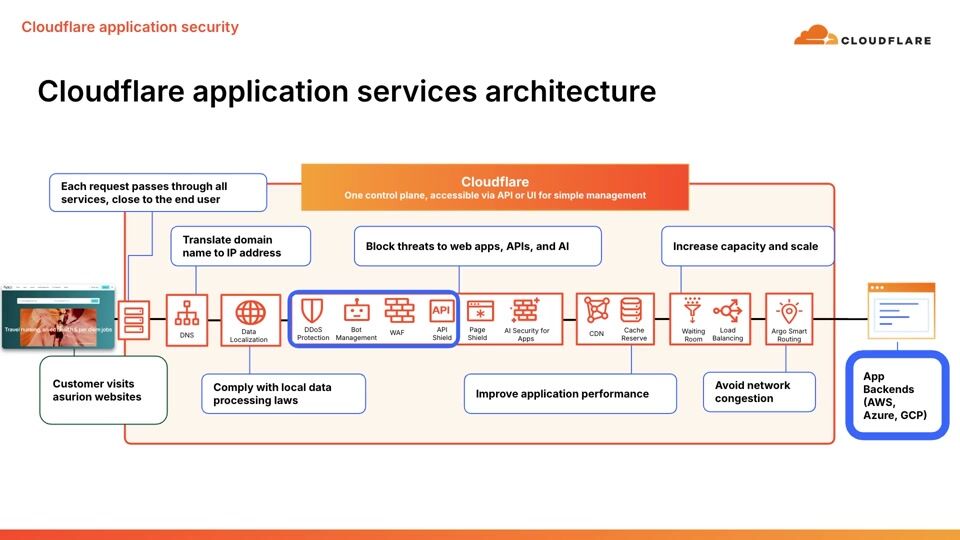
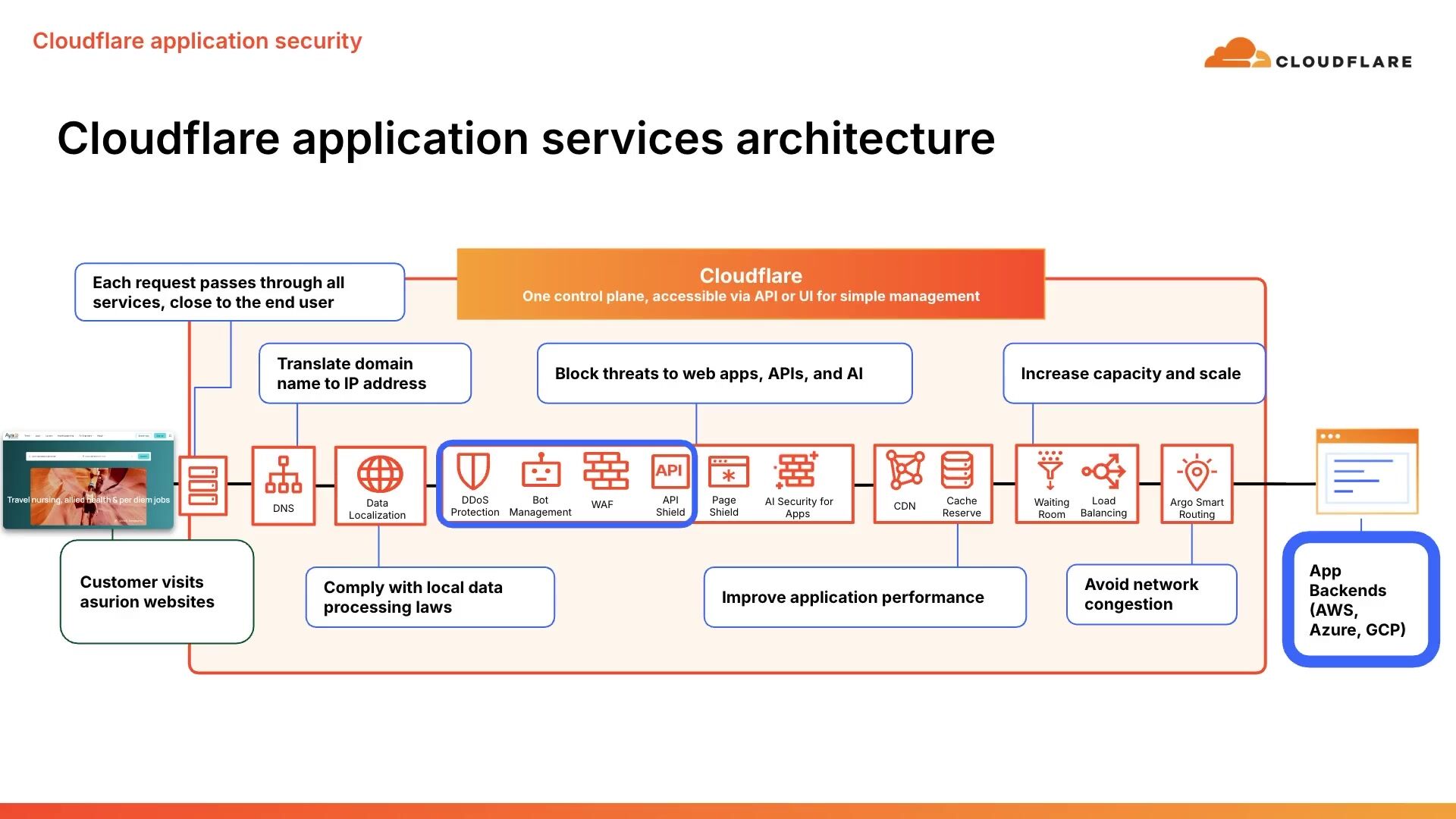
20:30So in our experience, we were seeing indications that we needed to add that additional layer. We need to push that stuff out. It gives us more time. It gives us time to adjust. And then it allows us to use our own tools to actually analyze the traffic into our WAC rules. So as there's no AI without API, we need to leverage the APIs provided by the Cloudflip platform in order to rapidly adjust our rule sets to an imperfect world. And... So that's how we leverage WAF, Cloudflare. Awesome. Thank you, sir. One of the things that I want to maybe kind of provide an illustration for to align with some of Jason's wording there, again, just in case anybody in the audience is not familiar with Cloudflare application security services in particular, in this context, we're using DNS as the control plane.
21:23So once there's at least one public domain, public host name that Cloudflare owns, that's what attracts the traffic to our global Anycast Edge. here as part of that orange rectangle. So that would represent tens of thousands of servers across 800 data centers globally. And so leveraging DNS means there's just not a lot to do other than maintain the configuration. So the infrastructure is just there at auto scales under the hood, having 534 terabits of bandwidth to play with as that traffic reaches our edge, whether it's a volumetric attack or otherwise, it just kind of happens. There's really no need. think about, you know, do I need to add some sort of auto-scaling capability? That just happens. And so we are able to, once we own that host name, we're able to just have a toggle switch that proxies the connection and then enables things like web application firewall, bot management, API shield related traffic.
22:16And that is true regardless of where the backend components live. So the backend web components could still be on AWS Azure GCP on -prem. or otherwise, we're just moving the perimeter as far away from the infrastructure as possible as Jason described. So, awesome. Again, I'll leave this in the backdrop. Just kind of wanted to step back through that in case anybody wasn't picturing this, don't already have this type of solution. I think that's helpful or at least it was for me when I started here. And with that, I think I'll jump into the second question. Many healthcare platforms run application logic across complex hyperscalers like AWS, Azure.
23:23a principal driver, complexity, and really speed to deployment. Cold starts, deploys. How do we get that worker workload running rapidly and simply? How do we drive agility? How do we do development in more real time? How do we do previews? All the things that what I would consider a high volume. costy infrastructure should be able to support. And for us, that was Cloudflare workers. And as we've migrated our workloads, we've found those outcomes. It's near instantaneous to deploy our UIs. We can preview them. And that's the tip of the iceberg before we even get to the optimization of the UI itself.
24:10So it gives us that capability also to ultimately decouple our backend from the front end. And again, you know, as that traffic may hit, we need to scale. It's easy to do that. And it's all API driven. It's, you know, it gives us a very low friction point to make changes, to adapt. So it really sets you up for a future where we don't necessarily need to worry so much about a heavyweight UI, which shouldn't be heavyweight in the first place. And just think about, you know, hey, we want to make this left shift. We want to make it, you know, agentic forward. and we want to make it something that's easy to do and very adaptable and agile for our developers to leverage.
24:57Excellent. Thank you so much. That's one of those areas where, for me, I've spent the better part of three decades kind of focused more on SASE-type stuff before we called it SASE. So the concept of lift and shift versus serverless compute was kind of newer to me when I started here. V8 isolates instead of container. the benefits of that scaling to zero some of those things were newer to me so i'm hearing the benefits of that firsthand from uh just an incredible environment like this is incredibly useful and authentication was made really easy i mean that that was a real you know opportunity as well integrating that through the cloudflare platform was you know it really made it a much easier lift to go from our traditional hosting back end to cloudflare awesome yeah good to hear i i know for me at least A lot of the solutions I worked with in the past, you know, a lot of times there'd be a finite amount of ASICs, FPGA, CPU, RAM, and that in this context would translate to maybe I can only integrate with Active Directory or maybe one identity provider.
25:58In this case, since we've got so much horsepower on the backend, you can integrate as many IDPs as you need and kind of move the users and groups into individual WAF gateway policies. And that just kind of streamlines things on the end user side as well as the administrative side. Well, I think in order to maybe leave a little bit of time at the end after our third guest, I'm going to call it for now, but thank you so much for your time, sir. Appreciate it. Thank you. Appreciate it.
26:28All right. And before I bring up my third and final guest, I just want to, while I'm on this screen, just kind of double click on one newish offering in case anybody is not familiar with it. So I just clicked and exposed. AI security for apps. So for anybody that is looking at Cloudflare WAF or may already have it, about 18 months ago, we introduced AI security for apps, which has essentially given you the ability to, often I'll use like an AI -enabled chatbot on your public -facing website as an example of a common use case. So if you're worried about whoever or whatever is able to hit that chatbot and its communication to the app, LLM and what it might be trying to extract, our AI security for apps sits in line there and essentially gives you the ability to first discover LLMs, differentiate between any of the models that you might be using versus maybe somebody in your organization stood up and was using a model and it wasn't considered approved.
27:26That kind of discovery, once we have the host name, we'd have visibility into all of the above. So maximizing visibility and and then inserting inline AI guard rail. So prompt detection, direct or indirect, and then DLP related controls.
27:46All right. So last, but certainly not least, please help me welcome to stage Emory Cox from Inspira.
28:00All right, let's do it. Appreciate your time. You wanna introduce yourself? quick? Yeah, am I on? Hi, I'm Emery Cox. I'm the chief architect at Inspire Financial. Inspire Financial runs a lot of different financial products. I'm focused primarily on health and benefits. So think about if you have an HSA, FSA, et cetera. I've been there for six years and I've kind of worked across the stack with a lot of focus on payments and recently AI. So happy to be here and chat a little bit about that. Awesome. Thank you so much. This is for me, one of those areas. I'm just going to... have this in the backdrop while I elaborate. For me, again, kind of extending my statement a minute ago about network security, cybersecurity, but kind of more SASE-related stuff, comfortable with those areas, I have spent less time, I would say, on application programming interface -related security, mutual TLS.
28:50You know, I can talk to it, I understand it, but how I would implement it in the context of APIs, it's kind of a newer space to me. So, I'm incredibly excited for these questions and answers. And again, I apologize in advance that they're a little bit long-winded, but that was intentional. So with that, I'll jump in here. So Inspira operates at an intense intersection. Your API payloads touch both HIPAA regulated health data and real banking ledger balances. From an architectural perspective, why is a traditional negative security WAF model insufficient for financial ledger? APIs? And how does enforcing a positive security model with open API schemas at the edge protect your ledger from parameter tampering and invalid state mutations?
29:35Yeah, right. Well, everything starts somewhere, right? You know, and we talked a lot earlier on a slide about defense in depth. And so a WAF certainly can play a role, but payments in healthcare are zero trust domains, you know, and a WAF is going to be a default allow solution, whereas we really need to enforce default deny on all of our requests you know when we think about like payment and ledger apis we already have enough complexity in the actual domain there and so we use all the techniques available to us to narrow what we have to focus on and schema validation is one of the ways to narrow the surface area for our api and it narrows things like parameter tampering etc you know and then shifting that to the edge with the tool like api shield gives us kind of the best operational model and you know A lot of the validation errors they're going to run into are benign, but when it matters, when there's a DDoS attack, shifting it to the edge eliminates that from our concern at all.
30:32So we don't have to worry about getting attacks with large payloads or deeply nested payloads and things like that. Now, for a ledger, the most dangerous request actually isn't going to be an invalid request. It's going to be a valid looking one, maybe a payment that's replayed with a changed recipient or changed amounts. And that's something that's hard or impossible maybe to identify with a validation signature. And so the highest leverage tool that you have in your API design or with your API defense is actually your API design, because you can't tamper with a parameter that's not exposed. And the last thing here is that AI is really accelerating what we're seeing here and kind of making this a much more urgent topic. You know, for us, we're starting to see MCP and CLI as some of the primary ways that people are interacting with our API. And with that, we're seeing a shift in traffic and all sorts of new.
31:20patterns we didn't anticipate. You know, an agent can, you know, learn an API far faster than any attacker could. And so, you know, again, schema validation at the edge isn't going to necessarily inhibit that, but it's one way to get a fast feedback loop for the agent and to give us observability and control here. Awesome. Thank you, sir. Maybe peeling back the onion one layer deeper. In the health benefits ecosystem, your APIs aren't just queried by end users, as you just described. You're ingesting web hooks and transaction calls from, for example, sponsor banks, TPAs, and pharmacy benefit networks. As standard API tokens and static keys increasingly leak, how does implementing mutual TLS at the Cloudflare edge enforce cryptographic client identity and eliminate man -in -the -middle risks across partner rails?
32:07Yeah, I'm certainly a big fan of simple as best, and so you can get a long way for certain things. with OAuth tokens and short-lived tokens. But the problem with tokens and credentials comes down to trust. These are things that you send on every request, and they end up in places like CI systems, log files, and just a lot of other places that you should be worried about. You know, and when the operations move money, that's not good enough. You know, and another thing I'll say is that with agents, like, the risk is amplifying here, because it's easier than ever for a token to get leaked. And on the flip side of that, a leaked token can be used faster than ever as well. So MTLS provides a structural zero trust solution that limits the impact and the risk of things like credential leakage and eliminates man in the middle concerns for us.
32:59You know, you can still have a leaked token, but because we have authenticated both the client and the server, that token can't be used. So the impact is mitigated. The thing about MTLS, the biggest risk is operational. You know, a certificate mistake looks like an outage. And so by managing that at the edge, it gives us the best operational posture, especially in these disaster recovery scenarios. Now, not every bank or every partner you integrate with is going to be able to implement something like MTLS. You know, like a lot of banking stuff still runs on files daily. So the bigger question is, how do you kind of apply zero trust at every interaction? You know, and things like Identity Federation or IP. restrictions, request signatures, PGP file encryption. These are all tools we use to defend in depth at every step and every layer.
33:45Awesome. One of the things that MTLS kind of reminds me of, I had a Gartner event heavy summer and across all of those events, 85 % of them were AI related and a big, I would say, undercurrent was the sort of gap that we have with when it comes to AI and an inability to do basic things. like multi-factor authentication, since in that context, we're talking about software running on top of software, and it's not going to have the option to reach out and touch a FIDO2 capable YubiKey or insert a smart card. So a little bit of an adjacent topic there. But to me, the concept of mutual TLS is not necessarily going to be the new thing that solves for that specifically, but it's something that's been around forever. I think a lot of us are aware of it, but maybe haven't taken the time to implement it.
34:32And just that feels to me like a newer, uh, area that we need to kind of compensate for since the absence of multi-factor authentication, I think just highlights a major gap in any basic zero trust framework. So awesome to see that, you know, implemented, I'm sure even before any of this AI stuff came up. Sometimes you have partners that need it, right? And that's great. You know, like that's how we bring the industry forward. Yeah. Awesome. All right. Let's take it one step further. So if we think about things like, Like HSAs, FSAs, so health benefits accounts, and benefit debit cards face automated threats like low and slow card testing and bot -driven balance scraping.
35:17How is Inspire leveraging edge -based machine learning and behavioral anomaly scoring to identify and block fraudulent transaction patterns in real time without creating latency that causes cardholder declines at the pharmacy counter, for example? Yeah, well, you know, a lot of the first orders. signals are actually pretty naive. So it makes implementation a little bit easier. I mean, things just like, you know, velocity of spend or anomalous amounts or geographic anomalies. But you kind of hinted at it, right? Like the authorization loop, you have to be really fast to be in that. And, you know, nothing's worse for your NPS than a card decline. In payments, one thing we talk a lot about is shared responsibility. So we have a shared responsibility with the network and the issuer processor for fraud detection. And we get a really pass from both of them before we're involved in a decision at all but then from there we kind of apply two things so one of them is real time in the offload and the other is in the background pushing configuration updates to the offload again in the offload you have to be really fast and so you need to do a lot of pre-computation you need to pre-compute your model and your features and you need to have those in memory before you're getting any data from the network you know and similarly you need to bring all of your data close to the edge so that you can get it really quickly in real time you need to go through a big performance testing process for launch and for any change you're going to do and then you also need to make business decisions about if you're going to fail open or fail closed and you might want to do that on a risk basis now outside of the off flow you can get a little more creative and in our system we get a notification for every transaction event milliseconds after it happens
36:52and that's where we do a lot of our scoring and detection so when we when we notice an event, what we do is we push updates to the issuer processor over the API. And so that's going to influence the subsequent swipe decisions. So we might not catch the first swipe, but we'll stop the second one. And there's a choice for us to around whether we disclose that or not, because in some fraud scenarios, you might not actually want to tip the fraudster off that you're onto their trail. Now, away from the swipe, you can actually be a lot more flexible because you rarely have the same tight time boundaries, but all the investment you've put into like models that go into the swipe layer are going to be really useful in that background processing as well and just one last thing i want to talk a little bit about is like one of the fraud vectors we actually see increasingly more than card level fraud is actually program level fraud business fraud which is like someone sells in a false employer for fsas that can be pretty attractive because all the funds are available on day one and depending on how things go sometimes people people can be spending when money is not in the account and so the way we detect that is actually very similar to how we look at cards.
37:55Instead of looking at the money going out, we apply similar rules to the money going in and look at things like ACH returns, et cetera. You know, one thing to be careful for with healthcare, though, is like a bad decline could be somebody in the hospital or like every employee at once. So it's important to be careful with any system you put in place here.
38:18One of the many reasons I was excited about this just kind of broader set of topics today is just because we all go to doctors, we all go to pharmacies. Like there's so many, you know, whether you're on the kind of IT or cybersecurity side of this, or you're a customer, there's just so many relatable elements. And I don't know about everybody else, but I think for me, I was just kind of picturing myself, my wife, now my daughters, you know, all kind of having different injuries this last year. Both my daughters play soccer and we had a bunch of, you know, stuff. We needed to leverage our HSA account of four. And it was just, you know, being in the cybersecurity world, it's just kind of, I think, fun's the right word for it to hear what all goes on behind the scenes. And again, appreciate everything you guys are doing. So I think we've got time for one more, and then we'll probably transition to Q &A in case anybody has any questions.
39:09So last question for today, looking across the broader healthcare landscape, we are seeing rapid adoption of autonomous AI agents to. automate claims adjudication, prior authorizations, and benefits reconciliation. As AI agents begin autonomously initiating and approving healthcare financial transactions, what architectural guardrails are needed at the network and API edge to govern these machine -to -machine workflows safely? Yeah. So you got to solve for three things, which are going to be observability, control, and explainability. And the first thing you need to do is you need to do a lot of need to be thinking about with these systems and this data is zero trust. And that's going to start with PII and PHI. You're going to want to route all of your model inputs and outputs kind of through a central gateway, and you're going to want to look for PII and PHI in there.
39:57And you probably, for these types of systems, you probably can't do the naive thing of just redacting everything. Some of these systems might require some of that data. You might be processing files and claims. And with the file, it's really... hard to know what's on that file until you've scanned it so you need really good controls here i'd also recommend schema validation so you're only allowing known fields tokenizing any phi you get and then thinking about a solution for files there's some things i could mention there the next thing is prompt injection you know if your primary interface with an llm is like chat you're maybe not thinking about this day in day out but this is still really relevant for ai systems uh any input to an llm is untrust and like claims are full of untrusted user data between files, transaction descriptions, et cetera.
40:48So you need to guard every input, inspect every input and also audit responses to see if they were prompt injected and failed because of that. You know, I'd recommend a few other things too. You know, turn off the internet for your model, run it in a sandbox. Like the real thing you want to do is make sure you never allow for the condition known as the lethal trifecta, which is access to privacy. data, exposure to untrusted content with the ability to exfiltrate it. Another layer, identity and observability. Every agent needs its own identity, its own IM policies, own rate limits, own budget. And that needs to be enforced at the platform boundary, not at the prompt. And then you need to audit log all the actions that your agents take so that you have observability into that. I'd also recommend feature flags. They're very good. We love them in payments and it's very good for sleeping well at night.
41:38My guidance would be to make sure you test those before you launch them. I got a few more notes, but I see we're running on time. Last thing I say, LLM is judge, something we use for high-risk decisions. You can shift those failures left over there. Start easy, optimize the human loop that you have, and feed your learnings back into your system to keep learning. Awesome. Thank you so much, sir. Appreciate it.
42:05All right, Tim, we're right at the one. minute mark. So I will just wrap up here in case anyone has any questions for myself or the three panelists. One thing I wanted to just kind of leave in the backdrop is these were three examples. We've got case studies on our public website, so you can filter on healthcare if anybody wants to see or hear or read more about kind of adjacent or similar scenarios and use cases. Thank you so much.
Kathleen Peters, Jordan Hager
Experian · Q2 Software
John McCaffrey, Doga Ozturk
Suffolk County, New York · NYC Dept of Buildings
Michael Tremante
Cloudflare
Be the first to know when registration opens and the agenda goes live.
---
title: "Inside healthcare: Securing and scaling enterprise networks with AI"
url: "https://www.cloudflare.com/connect/2026/session/inside-healthcare-securing-and-scaling-enterprise-networks-with-ai"
year: 2026
---

# Inside healthcare: Securing and scaling enterprise networks with AI

[Watch session](https://www.cloudflare.com/connect/2026/session/inside-healthcare-securing-and-scaling-enterprise-networks-with-ai)

## Session details

- **Track:** Industries Showcase
- **Topics:** Emerging tech & post-quantum, Threat prevention & response, AI transformation

## About this session

Designed for technology leaders in healthcare, this showcase explores how to secure and scale infrastructure using AI. Regulated industries face complex challenges, from sophisticated application programming interface (API) vulnerabilities to hyper-volumetric, distributed denial-of-service (DDoS) attacks. Hear from industry peers on how they’re solving these threats and adding value with emerging technologies.

## Speakers

- [Aaron McAllister](https://www.cloudflare.com/connect/speakers/2471079) — Field CTO, Cloudflare
- [Emery Coxe](https://www.cloudflare.com/connect/speakers/2509054) — Chief Architect, Inspira Financial
- [Jacob Arledge](https://www.cloudflare.com/connect/speakers/2509055) — Cybersecurity Engineer, OhioHealth
- [Jason Shrack](https://www.cloudflare.com/connect/speakers/2509053) — Vice President of Platform Engineering & Services, Aya Healthcare

## Transcript

[0:03] so just briefly i always like to you know not knowing everybody's background or experience with the details of cloudflowers network i always want to make sure we have the same mental picture of this heading into all of these topics so one of the things for anyone who's seen me present before i'm quick to share is my end user experience in the four and a half years i've been here i live in denver colorado been to places like iceland london bangaluru sydney australia i travel around north america most weeks and in the four and a half years i've been here i've never once had to think about my the other end of my secure connectivity due because to this network primarily but also the the proximity between wherever i was and the closest cloudflare network so that's an example of end user experience performance and my user initiated flows heading outbound through cloudflare and they would get proxied by what's called our secure web gateway saying that primarily to contrast that the bulk of today's discussion, which is going to be more around inbound traffic.

[0:56] So traffic starting anywhere on the internet, good, bad, or otherwise, destined for public facing things and having to traverse Cloudflare's network. So we're going to start kind of from the bottom up in the context of the OSI model. We're going to leapfrog most of the layers, but we're going to spend a little bit of time on layer three and then move our way up to layer seven as we progress the topics. So before we get into the details here, I just wanted to

[1:39] kind of set the stage a little bit for who I'm about to bring up. I met him for the first time on site in Ohio a few months ago, and it was just kind of a down the hall conversation. I was listening to some of the things that he was doing with AI, kind of in his free time, but for a work-related activity. And I don't wanna steal his thunder, so I'm gonna leave it at that. So with that, please help me welcome Jacob Arledge from Ohio Health Up.

[2:11] Thank you, sir. How's your mic done? Uh, I'll just use the, I don't know if it's-

[2:19] All right, awesome. So, yeah, would you mind introducing yourself real quick, Jacob? Yeah, as Aaron said, I met him at our corporate office in Central Columbus, downtown, next to Riverside Hospital, our main hospital. And, yeah, he kind of was listening in to a lot of the AI pen testing I've been doing in my free time because I'm an independent researcher of that. And basically how we're using Cloudflare to secure services where we're able to enumerate them externally and potentially run. attacks. So that's kind of our context. Awesome. Thank you, sir. Before I jump into these questions that I have for Jacob, I want to kind of poke fun at myself. I was very intentional with these questions. I wanted to make sure that they were specific to the environment, specific to the organization. And what I'm really leading up to is that they're kind of verbose to a fault.

[3:05] So as I get into these, if anybody wants to take a nap or get a Starbucks, you're not going to hurt my feelings. All right. So let's jump into this first one here. So when an e -commerce or financial site experiences brief, degraded performance, users refresh or transactions queue. In healthcare, an edge outage means telehealth disconnection, lost patient telemetry, or in some cases, ambulance diversion. Could you paint a picture for us of what these hypervolumetric threats look like in practice today and why traditional data center scrubbing appliances were failing to keep up? with the scale of modern floods? Of course, so if you've been attending the conference the past couple of days, you would know that 31.4 terabits of data can be hitting our organization potentially.

[3:56] So I would say that our two on-prem data centers could not handle that, just first and foremost. Secondly, we don't have time for DDoS attacks. We really need to be ahead of them and that's why we use Cloudflare Magic Transit, DDoS protection. Our engineers don't have time. to perform BGP swings and all that other good stuff when we have operational things that we need to take care of. There's outages all the time. Our on-call is always called. There's no time for attacks because if there is an attack, it typically turns into a manhunt. So for the next month or so, we'll be hunting down who it was and try to get the FBI on them, more or less. But yeah, more or less, we just don't have time for attacks. The services are very sensitive.

[4:41] We need to make sure we're keeping our patients' trust in us and competence to get treated at our facilities. So really, we need a product that manages that. No one can really have that role. The seat is far too hot. These attackers aren't just your Joe Schmo that's using a free DDoS service. They're nation-state threat actors. So going up against that every day can be really stressful, and I don't think anybody wants to be in that position. Thank you so much. And one of the things I wanted to do, in case anybody's less familiar with the service that we're referring to, again, in contrast to the scenario that I described that was focused more on outbound traffic and in -user experience, this is referring to Cloudflare acting as the global middle mile for the internet, advertising public IP prefixes for OhioHealth in this example.

[5:30] So that all inbound traffic then comes to our edge, and then we deliver only the clean traffic. So, um, what? of the things that I hear often in meetings, kind of jokingly, but then once they adopt a service like this, it's just kind of a non -issue is, how much do I need to pay you to make my problem become yours? Again, kind of a joke, but when it comes to this always -on DDoS mitigation service, that's usually the feedback I get is that now I just, I don't have to think about that anymore. It's something that I was spending a lot of time on and that's just no longer the case. So, all right. Awesome. Thank you, sir. So a little intentional overlap here. You kind of already touched on this, but just in case there's anything you want to elaborate on. So healthcare IT teams are stretched thin and during a volumetric surge, waiting for human escalation or manual BGP traffic swinging is typically not an option.

[6:21] How does having autonomous inline edge mitigation change your daily operational posture and your SLA commitments back to clinical operations? Right. I would say I'd break it out into two parts, one being our NETSEC team, where they manage the everyday operations projects, the company's growing, so they need to be focused on all those products and expansion, managing on -prem firewalls, really everything at the edge should be secured by, you know, Cloud Player as a product. That said, we need to make sure we're setting up, you know, our OWASP top 10 and our... our cloud player spectrum so that we're able to have the managed rule sets take care of those threats. That's where I would come in with the vulnerability management portion and say we're setting up spectrum, we're managing or we're looking at the logs that are hitting the OWASP managed rule set and, you know, analyzing the traffic, making sure we're making managed exceptions for false positives, and then we want to increase the threshold so that future requests that are malicious are taken care of.

[7:29] And we don't have to worry about them. So, yeah, our end goal, obviously, get everything behind the WAF where we can. And we have exposed services, get it behind Spectrum. And then, you know, the next question is going to talk about the AI stuff. But, yes, that's we want everything at the edge to be automated so that we can focus on internal remediation so that they can't laterally move once they get it. Got it. Awesome. And one of the things you touched on there that I think is, for me, I just take for. granted, but your internet pipes themselves, just kind of keeping them clean, for a lack of better words, that's just kind of an ancillary benefit of the services being up as the main focus, but just keeping the bandwidth that you're paying for just, you know, isolated to the packets that belong and nothing else.

[8:14] I think that's part of the goal there. So, okay, awesome. So, yeah, we're going to turn the corner. Again, we're kind of taking our time moving up the OSI model here. And so as we creep into layer seven, I do want to just. revisit one thing show of hands how many people have heard of ai as many of you know um that i've worked with before that is unfortunately my best joke so uh it's downhill from here but all right on a serious note threat actors are increasingly using automated and ai generated polymorphic traffic attacks that change dynamically at layer seven to mimic legitimate clinician ehr requests how is your team using machine learning and behavioral anomaly scoring at the edge to distinguish genuine clinical queries from automated attacks yeah this is exactly it um what i had talked before on the last question the specific example was uh request request going to our patient portal um they were triggering a lot triggering a lot of um oas rules um and more or less like that's what we really need to be paying attention to because when we implement the control it's going to be patient care impacting um but yeah that that's typically what we're using with cloudflare is seeing all the the requests coming in um what type of requests as far as what they're what rules are triggering and then we're trying to stop it then and there um that said i would say more the ai pen testing that i've been doing it speaks to this better where we are not allowing

[9:45] the enumeration of the services we're not allowing attackers to you know and paste what they're seeing through an end map or whatever have you to the ai and says oh hey you want to run this uh oh judging on the the name of the site it's probably this back -end service that's running um and then that's exactly what the attacks are looking like nowadays it really lowers the bar for a lot of people myself included um i'm not i'm not an expert on pen testing but um you will see that nation state threat actors um freelance gray hat hackers masquerading as such where they're really trying to extore you for money and what they're doing is using the ai to try to break in uh whether they're fooling it to do an authorized pen test or they're they're running an llm that's able to do this they're going to try to get in enumerate all your stuff um traditionally what i've seen is that the ai won't cause destructive damage but what it can do is enumerate everything that's gotten a hold of and send it back to you and say all right this is every i was able to enumerate all the d I was able to enumerate these servers in your environment.

[10:48] We were trying to pentest here. Oh, this is where the SOC intercepted me. And it'll output that back to the user to where they can compile it into a report. And you can approach the company and be like, hey, I got into your systems. And I know you did because we got intercepted by the SOC. So that's what I was saying earlier where this whole thing can turn into a manhunt. That's why it's so important to protect things at the edge. We can't let an attacker get to the front door. and then allows me to focus again on the lateral movement internal remediation got it awesome one of the things i was thinking about as you described that was uh my one of my last jobs on the customer side was in boundary protection architecture for the missile defense agency and early on in my time there i had the job of walking around with backtrack now uh cali linux but booting to that cd and running in map scans and things like that but i could get to whatever i could get to in like an hour and it was just terribly inefficient manual unbelievable what some of these tools are kind of enabling us to do in so much less time these days.

[11:49] All right, so I think we've got time for one more question. So as your organization begins adopting AI -driven diagnostic tools, imaging analysis pipelines, and real -time medical assistance, the volume and velocity of network data are skyrocketing. How does a modern edge network architecture allow you to scale these AI workloads securely without creating new availability choke points yeah so this is this is a tough question um as far as what i know it's is in our environment uh we use ai doc um and what it does is it's able to analyze images but it's able to um be anonymous almost where you're feeding the image to the ai and it says oh yeah that this is a clean fracture here on the image or um this is somebody's uh an x -ray of their lungs we're seeing this these spats on the this could potentially be something whether it's like pneumonia or cancer or whatever um but that as far as i know that's what they use and um so i would say it's already scaled really because it's sas um because all the images they go on on prem but as far as the ai doing this analysis for us it's all sas based so um i would say it's scaled something else i learned about was the ambient listening so um basically when patients go into their room They get asked like, hey, are you okay if we record this?

[13:08] It's an AI transcribing all the stuff that the patients and the doctors are talking about. Again, it's a SaaS solution. And I would say it's already scaled fully in our environment. All of our care sites have it. So it's just dependent on whether or not the patient's like, oh, I'm okay with being recorded. Or maybe they have something more private to talk about. They're probably not asked to be recorded. Got it. Thank you so much. One kind of final... Jason thought there across my career. Anytime I was in like a service, internet service provider, higher ed, or even for the missile defense agency, the bulk of my job in the cyber security context was like keeping video feeds up. It was really nothing that was on this level in terms of for me, at least what would be very stressful. You know, if people can't get to email and things like that, that matters because it's, you know, it was my job to kind of keep that service up, but just, you know, the systems that you're protecting, obviously it's.

[14:02] on another level. So just thank you for everything that you do. And thank you so much for taking the time to join us today. Appreciate it.

[14:14] All right. We're off to a great start. Before I call up my next guest, I want to share just briefly a story from a week after Anthropic announced Mythos Preview. So Mythos Preview was announced on April 7th. Cloudflare has a very... strategic relationship with Anthropic and OpenAI. We've leveraged all the frontier cyber models for both defense and offense. A week later, I was in Austin for what's called the RHISAC Cybersecurity Summit, and a CISO said to me that Mythos Preview reminded him that gone are the days of being able to outrun the rain with faster patching. It's time to build a roof so that when it pours, the business remains dry. And he was referring to this concept of architecting around the... vulnerability. And so in Cloudflare's world, that roof is the global Anycast edge combined with the concept of a forward and reverse proxy.

[15:05] So as you move your users behind our secure web gateway, and as you move your apps behind our web application firewall, which would be acting as a full reverse proxy, those things by themselves go a long way to conceal your attack surface to the outside world. And Jacob kind of touched on that, the before and after, like this is what our web properties look like before they were behind Cloudflare and then go home, scan them externally. This is what it looks like afterwards, because now the scans are destined for a host name, but they're going to Cloudflare's global anycast edge that doesn't own any public unicast IP space. There's no magic way because we're acting as a reverse proxy for those packets to make their way to the back end system.

[15:51] So that by itself is a huge step in the right direction. Now, anybody that spends time in this field knows that you still have to implement configurations to best practices, and I would say that's what is the focus for at least part of the next two guests that I've got is, you know, what else can we be doing at these deeper, kind of more advanced layers when it comes to bot management, differentiating between humans and bots, and these days, whose agent is this, and what should it have access to API -related traffic? things like that. So the last thing I'll say before I invite my next guest up is that this architecture, especially for inbound traffic, a good portion of the goal here is to buy the team time to patch. Ideally, even though now CVEs are released or any kind of zero day, it takes about 22 minutes on average for those to be exploited.

[16:40] Once your stuff's behind Cloudflare, the team has more time to patch. That job doesn't go away, but instead of having to carry a pager and drive in in 22 minutes, it kind of becomes more of a CloudFlare problem since we're sitting in front of it at that point. All right, so again, we're kind of moving up the OSI model, talking a little bit more about what we can do at a layer seven now. So please help me welcome Jason Schreck from Aya Healthcare.

[17:17] Thank you, sir. Appreciate it. You want to give a quick introduction? Of course. I'm Jason Schrak. I'm the vice president of platform engineering and services for IA Healthcare. if you are not aware, probably are not, is the largest healthcare staffing provider in the United States. So we provide nurses, clinicians, anyone within a hospital system, any kind of placement within those organizations towards the goal of, you know. and promoting greater healthcare outcomes. So that's us in a nutshell. Awesome. Thank you, sir. All right. I'm just going to jump right in here because this is one of those environments where I just feel like the more kind of, I don't want to say complexity, because that word, depending upon how you interpret that, that can be good or bad.

[18:09] But I would say just the kind of the depth and breadth of what this organization sees on any given day, I would say, is much more involved to secure properly than certainly most of the environments that I was ever responsible for. So with that, I think I'll jump straight in. So as Jason touched on, iHealthcare powers the nation's largest digital staffing platform, connecting hundreds of thousands of clinicians with critical hospital shifts. These portals are prime targets for credential stuffing, aggressive scraping of pay rates, and layer seven exploits. So Jason, And how has Cloudflare WAF and Advanced Threat Intelligence helped you secure these candidate and hospital applications without adding friction or false positives that disrupt clinicians looking for urgent shifts?

[18:55] Well, it really gets back to adding layers of protection, right? It's introspection of traffic, classification, and then, you know, the defense. So it allows us to apply that kind of push that edge out and provide the moat. around our more, you know, soft inner core. It helps us early identify, you know, any kind of patterns, determine if they're malicious or if they're actually desired. A lot of the complexity in our world stems from scraping activity, what is good, what is bad, right? And the determination of which is which can be really difficult in our world. So, you know, what's a malicious attack versus an unintentional event actually propagated by one of our... our customers, our MSPs, you know, or another friendly party, we don't want to shut them down.

[19:44] They're our partners. They help us place, you know, nurses and clinicians. So how do we drive the outcomes we desire while defending the architecture and our internal services that provide those services to our customers? That's the cloud player layer. You know, AI being the great equalizer on both the, you know, the attack. and the defendee side, the amplitude, no one can ingest that in the real world, in your existing infrastructures, even large hyperscalers. That's a lot. So how do we partner with someone who can actually absorb that data or that attack amplitude? That's an increasing line that goes straight up year over year.

[20:30] So in our experience, we were seeing indications that we needed to add that additional layer. We need to push that stuff out. It gives us more time. It gives us time to adjust. And then it allows us to use our own tools to actually analyze the traffic into our WAC rules. So as there's no AI without API, we need to leverage the APIs provided by the Cloudflip platform in order to rapidly adjust our rule sets to an imperfect world. And... So that's how we leverage WAF, Cloudflare. Awesome. Thank you, sir. One of the things that I want to maybe kind of provide an illustration for to align with some of Jason's wording there, again, just in case anybody in the audience is not familiar with Cloudflare application security services in particular, in this context, we're using DNS as the control plane.

[21:23] So once there's at least one public domain, public host name that Cloudflare owns, that's what attracts the traffic to our global Anycast Edge. here as part of that orange rectangle. So that would represent tens of thousands of servers across 800 data centers globally. And so leveraging DNS means there's just not a lot to do other than maintain the configuration. So the infrastructure is just there at auto scales under the hood, having 534 terabits of bandwidth to play with as that traffic reaches our edge, whether it's a volumetric attack or otherwise, it just kind of happens. There's really no need. think about, you know, do I need to add some sort of auto-scaling capability? That just happens. And so we are able to, once we own that host name, we're able to just have a toggle switch that proxies the connection and then enables things like web application firewall, bot management, API shield related traffic.

[22:16] And that is true regardless of where the backend components live. So the backend web components could still be on AWS Azure GCP on -prem. or otherwise, we're just moving the perimeter as far away from the infrastructure as possible as Jason described. So, awesome. Again, I'll leave this in the backdrop. Just kind of wanted to step back through that in case anybody wasn't picturing this, don't already have this type of solution. I think that's helpful or at least it was for me when I started here. And with that, I think I'll jump into the second question. Many healthcare platforms run application logic across complex hyperscalers like AWS, Azure.

[23:23] a principal driver, complexity, and really speed to deployment. Cold starts, deploys. How do we get that worker workload running rapidly and simply? How do we drive agility? How do we do development in more real time? How do we do previews? All the things that what I would consider a high volume. costy infrastructure should be able to support. And for us, that was Cloudflare workers. And as we've migrated our workloads, we've found those outcomes. It's near instantaneous to deploy our UIs. We can preview them. And that's the tip of the iceberg before we even get to the optimization of the UI itself.

[24:10] So it gives us that capability also to ultimately decouple our backend from the front end. And again, you know, as that traffic may hit, we need to scale. It's easy to do that. And it's all API driven. It's, you know, it gives us a very low friction point to make changes, to adapt. So it really sets you up for a future where we don't necessarily need to worry so much about a heavyweight UI, which shouldn't be heavyweight in the first place. And just think about, you know, hey, we want to make this left shift. We want to make it, you know, agentic forward. and we want to make it something that's easy to do and very adaptable and agile for our developers to leverage.

[24:57] Excellent. Thank you so much. That's one of those areas where, for me, I've spent the better part of three decades kind of focused more on SASE-type stuff before we called it SASE. So the concept of lift and shift versus serverless compute was kind of newer to me when I started here. V8 isolates instead of container. the benefits of that scaling to zero some of those things were newer to me so i'm hearing the benefits of that firsthand from uh just an incredible environment like this is incredibly useful and authentication was made really easy i mean that that was a real you know opportunity as well integrating that through the cloudflare platform was you know it really made it a much easier lift to go from our traditional hosting back end to cloudflare awesome yeah good to hear i i know for me at least A lot of the solutions I worked with in the past, you know, a lot of times there'd be a finite amount of ASICs, FPGA, CPU, RAM, and that in this context would translate to maybe I can only integrate with Active Directory or maybe one identity provider.

[25:58] In this case, since we've got so much horsepower on the backend, you can integrate as many IDPs as you need and kind of move the users and groups into individual WAF gateway policies. And that just kind of streamlines things on the end user side as well as the administrative side. Well, I think in order to maybe leave a little bit of time at the end after our third guest, I'm going to call it for now, but thank you so much for your time, sir. Appreciate it. Thank you. Appreciate it.

[26:28] All right. And before I bring up my third and final guest, I just want to, while I'm on this screen, just kind of double click on one newish offering in case anybody is not familiar with it. So I just clicked and exposed. AI security for apps. So for anybody that is looking at Cloudflare WAF or may already have it, about 18 months ago, we introduced AI security for apps, which has essentially given you the ability to, often I'll use like an AI -enabled chatbot on your public -facing website as an example of a common use case. So if you're worried about whoever or whatever is able to hit that chatbot and its communication to the app, LLM and what it might be trying to extract, our AI security for apps sits in line there and essentially gives you the ability to first discover LLMs, differentiate between any of the models that you might be using versus maybe somebody in your organization stood up and was using a model and it wasn't considered approved.

[27:26] That kind of discovery, once we have the host name, we'd have visibility into all of the above. So maximizing visibility and and then inserting inline AI guard rail. So prompt detection, direct or indirect, and then DLP related controls.

[27:46] All right. So last, but certainly not least, please help me welcome to stage Emory Cox from Inspira.

[28:00] All right, let's do it. Appreciate your time. You wanna introduce yourself? quick? Yeah, am I on? Hi, I'm Emery Cox. I'm the chief architect at Inspire Financial. Inspire Financial runs a lot of different financial products. I'm focused primarily on health and benefits. So think about if you have an HSA, FSA, et cetera. I've been there for six years and I've kind of worked across the stack with a lot of focus on payments and recently AI. So happy to be here and chat a little bit about that. Awesome. Thank you so much. This is for me, one of those areas. I'm just going to... have this in the backdrop while I elaborate. For me, again, kind of extending my statement a minute ago about network security, cybersecurity, but kind of more SASE-related stuff, comfortable with those areas, I have spent less time, I would say, on application programming interface -related security, mutual TLS.

[28:50] You know, I can talk to it, I understand it, but how I would implement it in the context of APIs, it's kind of a newer space to me. So, I'm incredibly excited for these questions and answers. And again, I apologize in advance that they're a little bit long-winded, but that was intentional. So with that, I'll jump in here. So Inspira operates at an intense intersection. Your API payloads touch both HIPAA regulated health data and real banking ledger balances. From an architectural perspective, why is a traditional negative security WAF model insufficient for financial ledger? APIs? And how does enforcing a positive security model with open API schemas at the edge protect your ledger from parameter tampering and invalid state mutations?

[29:35] Yeah, right. Well, everything starts somewhere, right? You know, and we talked a lot earlier on a slide about defense in depth. And so a WAF certainly can play a role, but payments in healthcare are zero trust domains, you know, and a WAF is going to be a default allow solution, whereas we really need to enforce default deny on all of our requests you know when we think about like payment and ledger apis we already have enough complexity in the actual domain there and so we use all the techniques available to us to narrow what we have to focus on and schema validation is one of the ways to narrow the surface area for our api and it narrows things like parameter tampering etc you know and then shifting that to the edge with the tool like api shield gives us kind of the best operational model and you know A lot of the validation errors they're going to run into are benign, but when it matters, when there's a DDoS attack, shifting it to the edge eliminates that from our concern at all.

[30:32] So we don't have to worry about getting attacks with large payloads or deeply nested payloads and things like that. Now, for a ledger, the most dangerous request actually isn't going to be an invalid request. It's going to be a valid looking one, maybe a payment that's replayed with a changed recipient or changed amounts. And that's something that's hard or impossible maybe to identify with a validation signature. And so the highest leverage tool that you have in your API design or with your API defense is actually your API design, because you can't tamper with a parameter that's not exposed. And the last thing here is that AI is really accelerating what we're seeing here and kind of making this a much more urgent topic. You know, for us, we're starting to see MCP and CLI as some of the primary ways that people are interacting with our API. And with that, we're seeing a shift in traffic and all sorts of new.

[31:20] patterns we didn't anticipate. You know, an agent can, you know, learn an API far faster than any attacker could. And so, you know, again, schema validation at the edge isn't going to necessarily inhibit that, but it's one way to get a fast feedback loop for the agent and to give us observability and control here. Awesome. Thank you, sir. Maybe peeling back the onion one layer deeper. In the health benefits ecosystem, your APIs aren't just queried by end users, as you just described. You're ingesting web hooks and transaction calls from, for example, sponsor banks, TPAs, and pharmacy benefit networks. As standard API tokens and static keys increasingly leak, how does implementing mutual TLS at the Cloudflare edge enforce cryptographic client identity and eliminate man -in -the -middle risks across partner rails?

[32:07] Yeah, I'm certainly a big fan of simple as best, and so you can get a long way for certain things. with OAuth tokens and short-lived tokens. But the problem with tokens and credentials comes down to trust. These are things that you send on every request, and they end up in places like CI systems, log files, and just a lot of other places that you should be worried about. You know, and when the operations move money, that's not good enough. You know, and another thing I'll say is that with agents, like, the risk is amplifying here, because it's easier than ever for a token to get leaked. And on the flip side of that, a leaked token can be used faster than ever as well. So MTLS provides a structural zero trust solution that limits the impact and the risk of things like credential leakage and eliminates man in the middle concerns for us.

[32:59] You know, you can still have a leaked token, but because we have authenticated both the client and the server, that token can't be used. So the impact is mitigated. The thing about MTLS, the biggest risk is operational. You know, a certificate mistake looks like an outage. And so by managing that at the edge, it gives us the best operational posture, especially in these disaster recovery scenarios. Now, not every bank or every partner you integrate with is going to be able to implement something like MTLS. You know, like a lot of banking stuff still runs on files daily. So the bigger question is, how do you kind of apply zero trust at every interaction? You know, and things like Identity Federation or IP. restrictions, request signatures, PGP file encryption. These are all tools we use to defend in depth at every step and every layer.

[33:45] Awesome. One of the things that MTLS kind of reminds me of, I had a Gartner event heavy summer and across all of those events, 85 % of them were AI related and a big, I would say, undercurrent was the sort of gap that we have with when it comes to AI and an inability to do basic things. like multi-factor authentication, since in that context, we're talking about software running on top of software, and it's not going to have the option to reach out and touch a FIDO2 capable YubiKey or insert a smart card. So a little bit of an adjacent topic there. But to me, the concept of mutual TLS is not necessarily going to be the new thing that solves for that specifically, but it's something that's been around forever. I think a lot of us are aware of it, but maybe haven't taken the time to implement it.

[34:32] And just that feels to me like a newer, uh, area that we need to kind of compensate for since the absence of multi-factor authentication, I think just highlights a major gap in any basic zero trust framework. So awesome to see that, you know, implemented, I'm sure even before any of this AI stuff came up. Sometimes you have partners that need it, right? And that's great. You know, like that's how we bring the industry forward. Yeah. Awesome. All right. Let's take it one step further. So if we think about things like, Like HSAs, FSAs, so health benefits accounts, and benefit debit cards face automated threats like low and slow card testing and bot -driven balance scraping.

[35:17] How is Inspire leveraging edge -based machine learning and behavioral anomaly scoring to identify and block fraudulent transaction patterns in real time without creating latency that causes cardholder declines at the pharmacy counter, for example? Yeah, well, you know, a lot of the first orders. signals are actually pretty naive. So it makes implementation a little bit easier. I mean, things just like, you know, velocity of spend or anomalous amounts or geographic anomalies. But you kind of hinted at it, right? Like the authorization loop, you have to be really fast to be in that. And, you know, nothing's worse for your NPS than a card decline. In payments, one thing we talk a lot about is shared responsibility. So we have a shared responsibility with the network and the issuer processor for fraud detection. And we get a really pass from both of them before we're involved in a decision at all but then from there we kind of apply two things so one of them is real time in the offload and the other is in the background pushing configuration updates to the offload again in the offload you have to be really fast and so you need to do a lot of pre-computation you need to pre-compute your model and your features and you need to have those in memory before you're getting any data from the network you know and similarly you need to bring all of your data close to the edge so that you can get it really quickly in real time you need to go through a big performance testing process for launch and for any change you're going to do and then you also need to make business decisions about if you're going to fail open or fail closed and you might want to do that on a risk basis now outside of the off flow you can get a little more creative and in our system we get a notification for every transaction event milliseconds after it happens

[36:52] and that's where we do a lot of our scoring and detection so when we when we notice an event, what we do is we push updates to the issuer processor over the API. And so that's going to influence the subsequent swipe decisions. So we might not catch the first swipe, but we'll stop the second one. And there's a choice for us to around whether we disclose that or not, because in some fraud scenarios, you might not actually want to tip the fraudster off that you're onto their trail. Now, away from the swipe, you can actually be a lot more flexible because you rarely have the same tight time boundaries, but all the investment you've put into like models that go into the swipe layer are going to be really useful in that background processing as well and just one last thing i want to talk a little bit about is like one of the fraud vectors we actually see increasingly more than card level fraud is actually program level fraud business fraud which is like someone sells in a false employer for fsas that can be pretty attractive because all the funds are available on day one and depending on how things go sometimes people people can be spending when money is not in the account and so the way we detect that is actually very similar to how we look at cards.

[37:55] Instead of looking at the money going out, we apply similar rules to the money going in and look at things like ACH returns, et cetera. You know, one thing to be careful for with healthcare, though, is like a bad decline could be somebody in the hospital or like every employee at once. So it's important to be careful with any system you put in place here.

[38:18] One of the many reasons I was excited about this just kind of broader set of topics today is just because we all go to doctors, we all go to pharmacies. Like there's so many, you know, whether you're on the kind of IT or cybersecurity side of this, or you're a customer, there's just so many relatable elements. And I don't know about everybody else, but I think for me, I was just kind of picturing myself, my wife, now my daughters, you know, all kind of having different injuries this last year. Both my daughters play soccer and we had a bunch of, you know, stuff. We needed to leverage our HSA account of four. And it was just, you know, being in the cybersecurity world, it's just kind of, I think, fun's the right word for it to hear what all goes on behind the scenes. And again, appreciate everything you guys are doing. So I think we've got time for one more, and then we'll probably transition to Q &A in case anybody has any questions.

[39:09] So last question for today, looking across the broader healthcare landscape, we are seeing rapid adoption of autonomous AI agents to. automate claims adjudication, prior authorizations, and benefits reconciliation. As AI agents begin autonomously initiating and approving healthcare financial transactions, what architectural guardrails are needed at the network and API edge to govern these machine -to -machine workflows safely? Yeah. So you got to solve for three things, which are going to be observability, control, and explainability. And the first thing you need to do is you need to do a lot of need to be thinking about with these systems and this data is zero trust. And that's going to start with PII and PHI. You're going to want to route all of your model inputs and outputs kind of through a central gateway, and you're going to want to look for PII and PHI in there.

[39:57] And you probably, for these types of systems, you probably can't do the naive thing of just redacting everything. Some of these systems might require some of that data. You might be processing files and claims. And with the file, it's really... hard to know what's on that file until you've scanned it so you need really good controls here i'd also recommend schema validation so you're only allowing known fields tokenizing any phi you get and then thinking about a solution for files there's some things i could mention there the next thing is prompt injection you know if your primary interface with an llm is like chat you're maybe not thinking about this day in day out but this is still really relevant for ai systems uh any input to an llm is untrust and like claims are full of untrusted user data between files, transaction descriptions, et cetera.

[40:48] So you need to guard every input, inspect every input and also audit responses to see if they were prompt injected and failed because of that. You know, I'd recommend a few other things too. You know, turn off the internet for your model, run it in a sandbox. Like the real thing you want to do is make sure you never allow for the condition known as the lethal trifecta, which is access to privacy. data, exposure to untrusted content with the ability to exfiltrate it. Another layer, identity and observability. Every agent needs its own identity, its own IM policies, own rate limits, own budget. And that needs to be enforced at the platform boundary, not at the prompt. And then you need to audit log all the actions that your agents take so that you have observability into that. I'd also recommend feature flags. They're very good. We love them in payments and it's very good for sleeping well at night.

[41:38] My guidance would be to make sure you test those before you launch them. I got a few more notes, but I see we're running on time. Last thing I say, LLM is judge, something we use for high-risk decisions. You can shift those failures left over there. Start easy, optimize the human loop that you have, and feed your learnings back into your system to keep learning. Awesome. Thank you so much, sir. Appreciate it.

[42:05] All right, Tim, we're right at the one. minute mark. So I will just wrap up here in case anyone has any questions for myself or the three panelists. One thing I wanted to just kind of leave in the backdrop is these were three examples. We've got case studies on our public website, so you can filter on healthcare if anybody wants to see or hear or read more about kind of adjacent or similar scenarios and use cases. Thank you so much.

## Related sessions

- [Financial services panel: Resilience, security, and AI](https://www.cloudflare.com/connect/2026/session/financial-services-panel-resilience-security-and-ai)
- [Building modern state and local government security without starting over](https://www.cloudflare.com/connect/2026/session/building-modern-state-and-local-government-security-without-starting-over)
- [Building an open agentic Internet: Discoverable, callable, and payable](https://www.cloudflare.com/connect/2026/session/building-an-open-agentic-internet-discoverable-callable-and-payable)

## More from Connect

- [All sessions](https://www.cloudflare.com/connect/)
- [Get notified for Connect 2027](https://www.cloudflare.com/connect#2027)


