Web Performance & Frameworks
Co-engineering the future: How Uber & Cloudflare engineer a global platform


Steve Goldsmith, Mattie Toia
Cloudflare · Uber
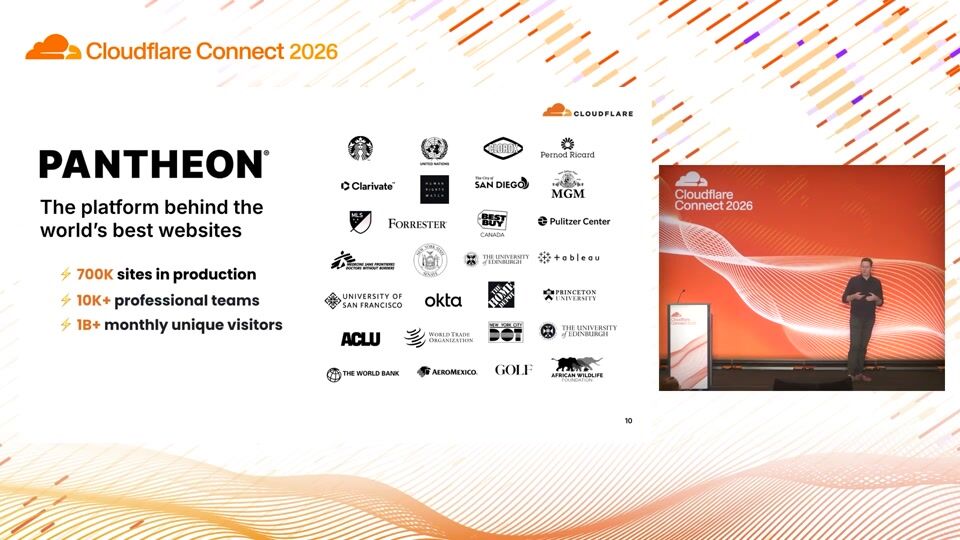
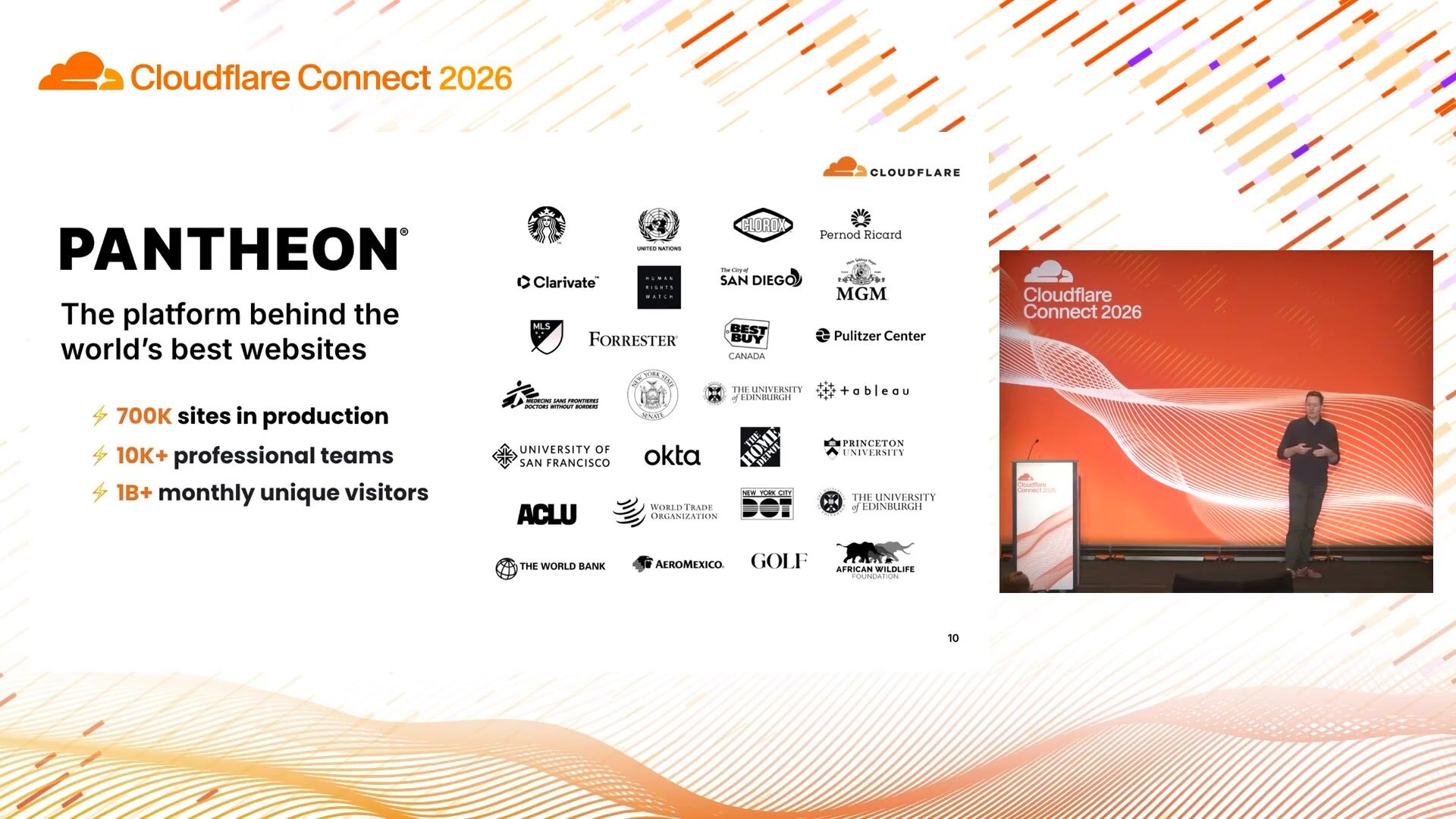
In 2025, Pantheon partnered with Cloudflare to power its global edge. Using Cloudflare primitives on the Cloudflare Development Platform, Pantheon scaled a great idea into an entirely new enterprise-grade product, P1, that is transforming how organizations build and run websites — in only seven months. In this session, Chris Yates, Pantheon’s SVP of Product, Design, and Engineering, shares the architecture behind P1. Learn how Pantheon combined Cloudflare Workers, Cloudflare Durable Objects, Cloudflare Workflows, Cloudflare Workers AI, Cloudflare AI Gateway, Cloudflare R2, and Cloudflare D1 to create an AI harness for human and agent workflows. Discover how to compose edge primitives, route models, and scale velocity without multiplying risk.
0:03first of all i'm chris i'm svp of product design and engineering at pantheon and i swear to god this isn't a product pitch talk it's maybe a little bit of a product pitch talk but mostly it's a case study it's kind of a story of the journey of how we built something pretty significant to our company and we hope people that build on the web in a really short period of time and um i had some other ideas for titles that got rejected. The first one was the web's not dead. Hopefully all of you believe that. It sounded like Matthew and our friends at Klavler also believe that. I am a bit of an open web fanatic. I work for and with a lot of open web fanatics and I've been working on the web almost my entire professional life. I've strayed a couple of times but I keep coming back to it.
0:49I keep getting pulled back in but now have this change in how the web works with the rise of agents as both creators and consumers Matthew talked about how we're gonna have a thousand times more people consuming than creating or agents consuming than people and so there's a lot of talk about what is whether the web is relevant or not what it's going to be is it going to be more relevant or less and what do we need to change I think the underlying thing is we need to change something The other rejected title is Rage Coding and You. So this is the story of how we took an offhand comment, not sure you can do that, and turned it into a product that two weeks ago I stood on a stage in Miami at Pantheon's slightly smaller user conference, but our first.
1:42And along with six of our customers, some that you probably know of, San Diego Zoo, MIT, UC Berkeley, Brown Forman, you might not know. them, but you might know Jack Daniels, came up and stood with us about, told them, told our customers and our colleagues how they're using this thing today. And the reason I'm here is because we couldn't have done that without Cloudflare. A little bit more about me. I've said I've been working on the web my entire professional life, either as a practitioner, building websites or building products for people that build websites. I've done a lot of things, marketing, software, sales, product engineering. And I, like our hosts at Cloudflare, I'm a firm believer in the value and the future of the open web. I worked in media education, SaaS, PaaS, even did a little stint as the web janitor for rocket scientists.
2:34And I was really pleased that one of my websites that I built way back when has now finally, like my son, old enough to vote. But unlike my son, that website is still helping conspiracy theorists find proof of ancient civilization. on Mars. So I'm going to show you a few things getting back to the topic I started with. Why not just vibe code all of this? Like that seems to be the thing. We vibe code stuff. We have agents build things for us, build code, and then put it somewhere. Cloudflare is a great place to do that. Why we might want to think differently. How this rage coding thing that I did turned into what we've built. And then I'll show you the little product. pitch. I swear to God it short. And more importantly, how Cloudflare made this all possible.
3:22This is the future of the web, right? So this is how we all are going to work. We are going to say to our favorite agent, yo agent, please make me a website, make no mistakes. And this is the world that I think content creators and owners have really always dreamed about, marketers have dreamed about, because whether they're marketers, merchandisers, political actors, governments, whatever, you can finally move as fast as you always wanted to, and 60% of the time it works every time. And you're unencovered by these pesky developers and content management systems and all the stuff that just makes things go slowly. And on LinkedIn, on LinkedIn, oh, nevermind. On LinkedIn, marketing folks are saying, well, I can just claw this. I moved my website to clawed.
4:08I moved my website to AI. I built all of this stuff really quickly. were able to move at the speed that was, you know, a year ago, impossible. But there's always been this tenuous balance on the web. Speed versus control, freedom versus frameworks, risk versus opportunity, marketing versus developers. So it's not just balance, but it's sometimes people coming to loggerheads about how things are supposed to work. So there might need to be something different because there's a problem. If you're a research university, you're an airline, you're a multinational corporation, you're a government, if you're the airport that most of us probably flew in here to get here today, on the one hand, you can't afford to not have agents helping you do more with what you have. But at the same time, can you really afford to have agents vibing all over the place, creating code, making every person in your web team and maybe across your entire organization into a developer?
5:01So Pantheon, my company, Money is built for websites that matter, whether you have one website or you have tens, hundreds, or thousands of websites that matter individually or in aggregate.
5:20So enter this term. The industry is starting to use the word guardrails a lot to describe what we need to do to constrain and guide AI. Guardrails are things that protect things from going off track, going rogue, going places where they're not supposed to go. But... I will argue that if you hit this guardrail, you are having a bad day already. Whether it keeps you from flying backwards down into the ravine below or not, that's a bad time. So something actually is needed that's different. Something else is needed, not just guardrails to box you in and hope that you can prod an agent or, frankly, people back into the right way of working, but actually something to create scaffolding, substrate, a harness.
6:07so being a good web zealot uh back in december i wrote a manifesto uh so it was actually more of a script that script turned into a prototype that prototype i took out and showed our board of directors and they were excited about that that was really cool they're like wow this is amazing i don't you're not going to pull that off you need to hire some kids to go do this with the ai and the things and like uh that brings me to the second piece myself and rejected title, Rage Coding and You. So on my flight home from that meeting from San Francisco back to Savannah, I had decent Wi -Fi, surprisingly. I had my good friend Claude riding shotgun and I had some motivation to prove a point that we could actually move faster than, frankly, I thought possible, but certainly others thought possible.
6:53But let me back up a second because I want to reset on what business that I'm in. We're in the business of running websites for companies and organizations that you probably interact with every day. So we provide posting, yes, because we have to. But what we really provide as value to our customers is the workflow, the orchestration, the frankly opinionated framework on how web development works for large organizations with websites that matter. So we've got workflows built in for sites, but also, more importantly, for fleets of sites. hundreds or thousands of websites, and we rely on Cloudflare as a key part of that platform that we deliver. So over the next couple of months, we're going to be migrating almost a million of those sites over to an edge powered entirely by Cloudflare.
7:42So driving security, driving optimization, driving bot mitigation for all of our customers.
7:49But that really, you know, the product, that whole matrix that I showed mostly focuses on one of these spheres, one of these- circles, it focuses on the people that, maybe like many of us, are developers or had development backgrounds. But what we saw was this need to change the way the web worked fundamentally, move it from kind of the endpoint of a creative process where you're working in different systems, you're working in Google Docs, you're working in Figma, you're working in, maybe you're not working, but some of your team is, in GitHub, GitLab, et cetera. It all comes together, maybe it goes through Asana or something else, and then outcomes. on the other side, but what we really needed was a platform where all these people, and now they're agents, could actually collaborate and iterate, improve all safely with human control for these websites that matter to them.
8:39So this is what came out the other end. Don't call it a CMS. It does some CMS-like things you'll see in a second. And we leveraged Cloudflare from the beginning to bring this from idea to angry clotting on a plane. into something that we have live customers running on and into public beta right now. And we did this with Cloudflare because we didn't have to think about a lot of the things that you would always have to think about, how to make things communicate with one another, how to think about infrastructure, horizontal and vertical scale.
9:15oh, we missed the music, but that's okay.
9:22This has what my wife and I quote said, this is music that you could shake your ass to.
9:29And there we go, a little bit of it. So this is our scissor reel from the product we launched a couple of weeks ago.
10:15So this is called pantheon p1 and it is the ai native web composition layer so what does that mean chris composition composition means a couple of things in p1 so it means that everything in p1 pages sites fleets of sites are actually composed of components you might call them blocks modules etc depending on you know your point of view on in the history of how you build on the web each of these are not just static components, but they're actually dynamic, things that can be configured and repurposed, changed, have different variations on them that are created by people or agents or people and agents working together so that you can reuse them across a fleet of sites.
11:03And the important thing is that when you build a site with P1, there's a code component. You create these as React components. This is actually not Pantheon's component library. This is one of our partners that created. almost 300 components for a variety of purposes. These are really kind of like public website sorts of components, but hidden in there, there's a whole set of dashboard components. You can build data visualizations. One of our sales engineers actually built a golf course builder and visualizer that allows you to drop a photo in and have an actual configurable course pop out the other side of it. Composable also that pages are manageable by humans and agents. We wanted to deliver this experience where people could edit in real time together, share feedback in real time, and where chat wasn't just a conversation that you have with one another, but it's actually a conduit for the action with the context of the work.
12:00So you can have a chat, whether it's with an agent or your colleague, start in the context of a component, a page, a site, a fleet of sites. And it actually carries along that context about what you want that particular agent or, frankly, person to do and what they should focus on, what they have to start with. And we wanted to build a system where agents had to be polite. So when we asked Zappi, our internal agent, backed by Cloudflare Workers AI that I'll show you in a second, to make a change, he's always showing what he's doing. So I should have grabbed the animated. gif version of this that gives the nice shiny animation there he's going to say where he's going to make the change and he can't mess with things that humans are working on and that required agents to be operating in a different way not just on the periphery of the system as a bolt-on over in the sidebar but actually integrated into the platform from the outset and the way that we do that and i could stop here as the unsung hero of that is cloudflare durable objects we needed this way to manage real-time collaboration where humans and agents whether they're browsers, they're an MCP, they're natively within the platform, are working together in real -time.
13:13So durable objects are workers with persistent storage. Each document in P1 is a durable object, and that's where the real-time collaboration, Google Docs style, happens. You can drag and drop and see your colleague doing the same. You can see the workers operating in the background. We also manage presence and collaboration at the document level through DOs. for this use case because this is the editorial path, they spin up where the editors are working and they put the application code directly alongside the storage. So the other important thing was that every P1 document can actually have infinite versions and we call these work streams. You can think of them like branches in Git. So each document might exist in a different state, say for a campaign, a new blog post, your site redesign.
14:02or anything in between all of those. Every one of those versions spins up a durable object, so the work that people and bots do in one campaign or one version of the document is isolated from the work that somebody else or maybe they and their other agents are doing in another version of the document. And we do that in a sparse way so that we're only creating new DOs when the documents are changing within the work stream. We also use these for other purposes, so settings, forms, translation. So all of this kind of CMS stuff ultimately becomes infinitely versionable. We can have these work streams for so many different purposes going inside the product. And of course the change to the website could be a single page or it could be the entire website at once. One of our earliest charter customers actually pushed 111, excuse me, 1100 rather, much bigger number, 1100 work streams in the span of like a week as they were migrating an existing over to p1 so those document edits happen in real time at the durable object layer and then we sync these changes through queues into hyperdrive and then sorry this is the only part that's not on cloudflare today it's blue for reasons into a postgres layer and that's where we kind of join all of these things together to give the context around the work stream you can think of that as a pull request in github but unlike a git which is just code, we don't want to expose code to people that don't care about code, they just care about the results.
15:32So we give you this visual comparison of the before state, what's on the live site, what's going to be changed, highlight all of those changes, show you where there are conflicts, whether there's in the metadata, in the content themselves. And importantly, we actually give you the ability to manage those conflicts. So to be able to say, well, actually something has changed because live websites change. and we wanted to be able to merge those things together. So you could pick either at the component level or even say, I want one button versus the other from the live and old version and do all that visually. And then when we press the go live button, which is the equivalent of a publish, we actually publish all of these changes. So all the code, all of the document changes, anything structural, all goes out through Cloudflare workflows.
16:19Hits R2, is served by workers, cached by the pan. on Global CDN, which, as I said, is powered by Cloudflare as well. And of course, I said earlier, P1 is an AI native platform. That's the other part. So you can interact directly with P1 documents via a built-in MCP server, or you can use our internal agent framework, ZAPI. I don't think that's going to be the official logo, but we like them anyway. ZAPI interacts with another layer of the Cloudflare stack that we just snapped together, frankly. We use AI. gateway to direct where queries go to different models. It also gives us caching and an additional observability layer about what people are doing, how people are interacting, whether queries and commands and prompts are working correctly.
17:07And behind that, we run open weight models, mostly running on workers AI using KimiK27 and others. But we can also route out to frontier models where needed and zappy works within workstream just like people do and then the mcp and the zappy service are actually implemented as workers as well i said earlier p1 isn't a cms but it needed to do some cms like stuff like managing uploading transformation delivery of media so we built the whole media and file handling pipeline on cloudflare as well to enable humans or agents to upload crop scale transform annotate and add metadata to images or other media or other files. And then we deliver that transformed media through Cloudflare images and the metadata via workers backed by D1 where that metadata is stored and can be searched, whether it's by an agent or by a human user.
18:05So what's next? That was a really quick breeze through of what we've built so far, and we wouldn't have been able to breeze through that so fast in terms of how we... deliver that to market, if not for the partnership that we've had with Cloudflare. What I didn't talk about is the one critical piece that's not on Cloudflare today, besides the other blue box, the Postgres database, is the actual website. So the website is Next.js. It runs on Pantheon's core platform. And that's where developers manage the code. They pull in their code from Git. They can align that with the work stream changes to content. And we need to know that. manage the combined publication of everything out with one single click. And one of the initiatives that we're working on is exploring both how can we support other JavaScript frameworks, and how can we move past the sandwich model that we have today.
18:59The other important thing that we're doing is actually making this whole agent model pluggable so that our customers and our partners can have their own agents to the platform that run in the background, perform tasks. We started with things like accessibility agents, but we see opportunities to do performance monitoring and campaign generation using some of the signals that our friends at Cloudflare talked about earlier to automatically generate improvements on the website and then present them for human approval.
19:28So I'm at time, and I just want to say I really appreciate the partnership that we've had with Cloudflare. I wouldn't be standing up here to give this talk if we hadn't been able to execute with the speed that this allowed. us to do and to continue to innovate at this pace. Love for you to explore what we're doing at Pantheon and P1. It's p1.pantheon.io. So thank you.
Steve Goldsmith, Mattie Toia
Cloudflare · Uber
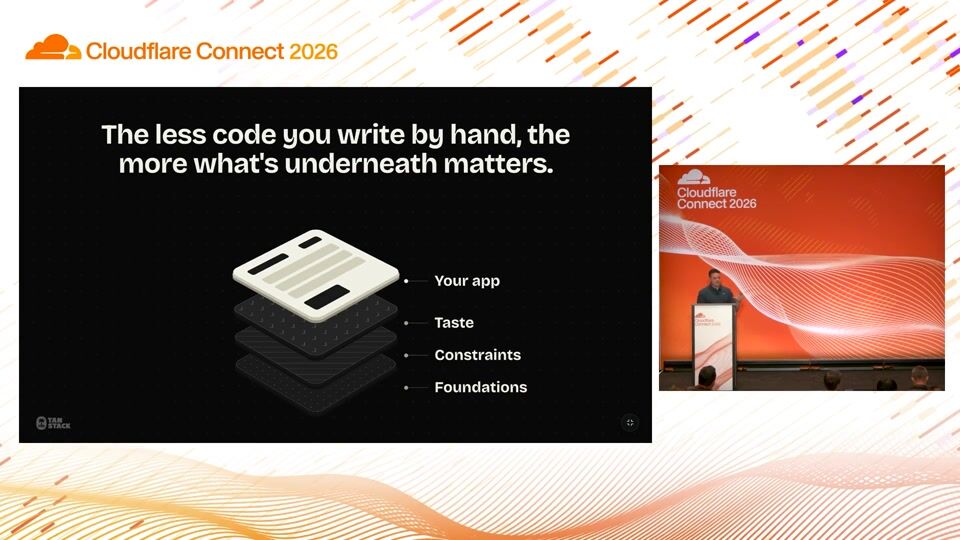
Tanner Linsley
TanStack
Alexander Braunreuther, Mark Dembo
Contentful · Cloudflare
Be the first to know when registration opens and the agenda goes live.
---
title: "Building P1 on Cloudflare: AI-native web composition and governance"
url: "https://www.cloudflare.com/connect/2026/session/building-p1-on-cloudflare-ai-native-web-composition-and-governance"
year: 2026
---

# Building P1 on Cloudflare: AI-native web composition and governance

[Watch session](https://www.cloudflare.com/connect/2026/session/building-p1-on-cloudflare-ai-native-web-composition-and-governance)

## Session details

- **Track:** Web Performance & Frameworks
- **Topics:** Customer Experience, Programmable Platforms, AI inference & workloads
- **Solution areas:** Application Performance, Developer Platform

## About this session

In 2025, Pantheon partnered with Cloudflare to power its global edge. Using Cloudflare primitives on the Cloudflare Development Platform, Pantheon scaled a great idea into an entirely new enterprise-grade product, P1, that is transforming how organizations build and run websites — in only seven months. In this session, Chris Yates, Pantheon’s SVP of Product, Design, and Engineering, shares the architecture behind P1. Learn how Pantheon combined Cloudflare Workers, Cloudflare Durable Objects, Cloudflare Workflows, Cloudflare Workers AI, Cloudflare AI Gateway, Cloudflare R2, and Cloudflare D1 to create an AI harness for human and agent workflows. Discover how to compose edge primitives, route models, and scale velocity without multiplying risk.

## Speakers

- [Chris Yates](https://www.cloudflare.com/connect/speakers/2527997) — SVP of Product, Design, and Engineering, Pantheon

## Transcript

[0:03] first of all i'm chris i'm svp of product design and engineering at pantheon and i swear to god this isn't a product pitch talk it's maybe a little bit of a product pitch talk but mostly it's a case study it's kind of a story of the journey of how we built something pretty significant to our company and we hope people that build on the web in a really short period of time and um i had some other ideas for titles that got rejected. The first one was the web's not dead. Hopefully all of you believe that. It sounded like Matthew and our friends at Klavler also believe that. I am a bit of an open web fanatic. I work for and with a lot of open web fanatics and I've been working on the web almost my entire professional life. I've strayed a couple of times but I keep coming back to it.

[0:49] I keep getting pulled back in but now have this change in how the web works with the rise of agents as both creators and consumers Matthew talked about how we're gonna have a thousand times more people consuming than creating or agents consuming than people and so there's a lot of talk about what is whether the web is relevant or not what it's going to be is it going to be more relevant or less and what do we need to change I think the underlying thing is we need to change something The other rejected title is Rage Coding and You. So this is the story of how we took an offhand comment, not sure you can do that, and turned it into a product that two weeks ago I stood on a stage in Miami at Pantheon's slightly smaller user conference, but our first.

[1:42] And along with six of our customers, some that you probably know of, San Diego Zoo, MIT, UC Berkeley, Brown Forman, you might not know. them, but you might know Jack Daniels, came up and stood with us about, told them, told our customers and our colleagues how they're using this thing today. And the reason I'm here is because we couldn't have done that without Cloudflare. A little bit more about me. I've said I've been working on the web my entire professional life, either as a practitioner, building websites or building products for people that build websites. I've done a lot of things, marketing, software, sales, product engineering. And I, like our hosts at Cloudflare, I'm a firm believer in the value and the future of the open web. I worked in media education, SaaS, PaaS, even did a little stint as the web janitor for rocket scientists.

[2:34] And I was really pleased that one of my websites that I built way back when has now finally, like my son, old enough to vote. But unlike my son, that website is still helping conspiracy theorists find proof of ancient civilization. on Mars. So I'm going to show you a few things getting back to the topic I started with. Why not just vibe code all of this? Like that seems to be the thing. We vibe code stuff. We have agents build things for us, build code, and then put it somewhere. Cloudflare is a great place to do that. Why we might want to think differently. How this rage coding thing that I did turned into what we've built. And then I'll show you the little product. pitch. I swear to God it short. And more importantly, how Cloudflare made this all possible.

[3:22] This is the future of the web, right? So this is how we all are going to work. We are going to say to our favorite agent, yo agent, please make me a website, make no mistakes. And this is the world that I think content creators and owners have really always dreamed about, marketers have dreamed about, because whether they're marketers, merchandisers, political actors, governments, whatever, you can finally move as fast as you always wanted to, and 60% of the time it works every time. And you're unencovered by these pesky developers and content management systems and all the stuff that just makes things go slowly. And on LinkedIn, on LinkedIn, oh, nevermind. On LinkedIn, marketing folks are saying, well, I can just claw this. I moved my website to clawed.

[4:08] I moved my website to AI. I built all of this stuff really quickly. were able to move at the speed that was, you know, a year ago, impossible. But there's always been this tenuous balance on the web. Speed versus control, freedom versus frameworks, risk versus opportunity, marketing versus developers. So it's not just balance, but it's sometimes people coming to loggerheads about how things are supposed to work. So there might need to be something different because there's a problem. If you're a research university, you're an airline, you're a multinational corporation, you're a government, if you're the airport that most of us probably flew in here to get here today, on the one hand, you can't afford to not have agents helping you do more with what you have. But at the same time, can you really afford to have agents vibing all over the place, creating code, making every person in your web team and maybe across your entire organization into a developer?

[5:01] So Pantheon, my company, Money is built for websites that matter, whether you have one website or you have tens, hundreds, or thousands of websites that matter individually or in aggregate.

[5:20] So enter this term. The industry is starting to use the word guardrails a lot to describe what we need to do to constrain and guide AI. Guardrails are things that protect things from going off track, going rogue, going places where they're not supposed to go. But... I will argue that if you hit this guardrail, you are having a bad day already. Whether it keeps you from flying backwards down into the ravine below or not, that's a bad time. So something actually is needed that's different. Something else is needed, not just guardrails to box you in and hope that you can prod an agent or, frankly, people back into the right way of working, but actually something to create scaffolding, substrate, a harness.

[6:07] so being a good web zealot uh back in december i wrote a manifesto uh so it was actually more of a script that script turned into a prototype that prototype i took out and showed our board of directors and they were excited about that that was really cool they're like wow this is amazing i don't you're not going to pull that off you need to hire some kids to go do this with the ai and the things and like uh that brings me to the second piece myself and rejected title, Rage Coding and You. So on my flight home from that meeting from San Francisco back to Savannah, I had decent Wi -Fi, surprisingly. I had my good friend Claude riding shotgun and I had some motivation to prove a point that we could actually move faster than, frankly, I thought possible, but certainly others thought possible.

[6:53] But let me back up a second because I want to reset on what business that I'm in. We're in the business of running websites for companies and organizations that you probably interact with every day. So we provide posting, yes, because we have to. But what we really provide as value to our customers is the workflow, the orchestration, the frankly opinionated framework on how web development works for large organizations with websites that matter. So we've got workflows built in for sites, but also, more importantly, for fleets of sites. hundreds or thousands of websites, and we rely on Cloudflare as a key part of that platform that we deliver. So over the next couple of months, we're going to be migrating almost a million of those sites over to an edge powered entirely by Cloudflare.

[7:42] So driving security, driving optimization, driving bot mitigation for all of our customers.

[7:49] But that really, you know, the product, that whole matrix that I showed mostly focuses on one of these spheres, one of these- circles, it focuses on the people that, maybe like many of us, are developers or had development backgrounds. But what we saw was this need to change the way the web worked fundamentally, move it from kind of the endpoint of a creative process where you're working in different systems, you're working in Google Docs, you're working in Figma, you're working in, maybe you're not working, but some of your team is, in GitHub, GitLab, et cetera. It all comes together, maybe it goes through Asana or something else, and then outcomes. on the other side, but what we really needed was a platform where all these people, and now they're agents, could actually collaborate and iterate, improve all safely with human control for these websites that matter to them.

[8:39] So this is what came out the other end. Don't call it a CMS. It does some CMS-like things you'll see in a second. And we leveraged Cloudflare from the beginning to bring this from idea to angry clotting on a plane. into something that we have live customers running on and into public beta right now. And we did this with Cloudflare because we didn't have to think about a lot of the things that you would always have to think about, how to make things communicate with one another, how to think about infrastructure, horizontal and vertical scale.

[9:15] oh, we missed the music, but that's okay.

[9:22] This has what my wife and I quote said, this is music that you could shake your ass to.

[9:29] And there we go, a little bit of it. So this is our scissor reel from the product we launched a couple of weeks ago.

[10:15] So this is called pantheon p1 and it is the ai native web composition layer so what does that mean chris composition composition means a couple of things in p1 so it means that everything in p1 pages sites fleets of sites are actually composed of components you might call them blocks modules etc depending on you know your point of view on in the history of how you build on the web each of these are not just static components, but they're actually dynamic, things that can be configured and repurposed, changed, have different variations on them that are created by people or agents or people and agents working together so that you can reuse them across a fleet of sites.

[11:03] And the important thing is that when you build a site with P1, there's a code component. You create these as React components. This is actually not Pantheon's component library. This is one of our partners that created. almost 300 components for a variety of purposes. These are really kind of like public website sorts of components, but hidden in there, there's a whole set of dashboard components. You can build data visualizations. One of our sales engineers actually built a golf course builder and visualizer that allows you to drop a photo in and have an actual configurable course pop out the other side of it. Composable also that pages are manageable by humans and agents. We wanted to deliver this experience where people could edit in real time together, share feedback in real time, and where chat wasn't just a conversation that you have with one another, but it's actually a conduit for the action with the context of the work.

[12:00] So you can have a chat, whether it's with an agent or your colleague, start in the context of a component, a page, a site, a fleet of sites. And it actually carries along that context about what you want that particular agent or, frankly, person to do and what they should focus on, what they have to start with. And we wanted to build a system where agents had to be polite. So when we asked Zappi, our internal agent, backed by Cloudflare Workers AI that I'll show you in a second, to make a change, he's always showing what he's doing. So I should have grabbed the animated. gif version of this that gives the nice shiny animation there he's going to say where he's going to make the change and he can't mess with things that humans are working on and that required agents to be operating in a different way not just on the periphery of the system as a bolt-on over in the sidebar but actually integrated into the platform from the outset and the way that we do that and i could stop here as the unsung hero of that is cloudflare durable objects we needed this way to manage real-time collaboration where humans and agents whether they're browsers, they're an MCP, they're natively within the platform, are working together in real -time.

[13:13] So durable objects are workers with persistent storage. Each document in P1 is a durable object, and that's where the real-time collaboration, Google Docs style, happens. You can drag and drop and see your colleague doing the same. You can see the workers operating in the background. We also manage presence and collaboration at the document level through DOs. for this use case because this is the editorial path, they spin up where the editors are working and they put the application code directly alongside the storage. So the other important thing was that every P1 document can actually have infinite versions and we call these work streams. You can think of them like branches in Git. So each document might exist in a different state, say for a campaign, a new blog post, your site redesign.

[14:02] or anything in between all of those. Every one of those versions spins up a durable object, so the work that people and bots do in one campaign or one version of the document is isolated from the work that somebody else or maybe they and their other agents are doing in another version of the document. And we do that in a sparse way so that we're only creating new DOs when the documents are changing within the work stream. We also use these for other purposes, so settings, forms, translation. So all of this kind of CMS stuff ultimately becomes infinitely versionable. We can have these work streams for so many different purposes going inside the product. And of course the change to the website could be a single page or it could be the entire website at once. One of our earliest charter customers actually pushed 111, excuse me, 1100 rather, much bigger number, 1100 work streams in the span of like a week as they were migrating an existing over to p1 so those document edits happen in real time at the durable object layer and then we sync these changes through queues into hyperdrive and then sorry this is the only part that's not on cloudflare today it's blue for reasons into a postgres layer and that's where we kind of join all of these things together to give the context around the work stream you can think of that as a pull request in github but unlike a git which is just code, we don't want to expose code to people that don't care about code, they just care about the results.

[15:32] So we give you this visual comparison of the before state, what's on the live site, what's going to be changed, highlight all of those changes, show you where there are conflicts, whether there's in the metadata, in the content themselves. And importantly, we actually give you the ability to manage those conflicts. So to be able to say, well, actually something has changed because live websites change. and we wanted to be able to merge those things together. So you could pick either at the component level or even say, I want one button versus the other from the live and old version and do all that visually. And then when we press the go live button, which is the equivalent of a publish, we actually publish all of these changes. So all the code, all of the document changes, anything structural, all goes out through Cloudflare workflows.

[16:19] Hits R2, is served by workers, cached by the pan. on Global CDN, which, as I said, is powered by Cloudflare as well. And of course, I said earlier, P1 is an AI native platform. That's the other part. So you can interact directly with P1 documents via a built-in MCP server, or you can use our internal agent framework, ZAPI. I don't think that's going to be the official logo, but we like them anyway. ZAPI interacts with another layer of the Cloudflare stack that we just snapped together, frankly. We use AI. gateway to direct where queries go to different models. It also gives us caching and an additional observability layer about what people are doing, how people are interacting, whether queries and commands and prompts are working correctly.

[17:07] And behind that, we run open weight models, mostly running on workers AI using KimiK27 and others. But we can also route out to frontier models where needed and zappy works within workstream just like people do and then the mcp and the zappy service are actually implemented as workers as well i said earlier p1 isn't a cms but it needed to do some cms like stuff like managing uploading transformation delivery of media so we built the whole media and file handling pipeline on cloudflare as well to enable humans or agents to upload crop scale transform annotate and add metadata to images or other media or other files. And then we deliver that transformed media through Cloudflare images and the metadata via workers backed by D1 where that metadata is stored and can be searched, whether it's by an agent or by a human user.

[18:05] So what's next? That was a really quick breeze through of what we've built so far, and we wouldn't have been able to breeze through that so fast in terms of how we... deliver that to market, if not for the partnership that we've had with Cloudflare. What I didn't talk about is the one critical piece that's not on Cloudflare today, besides the other blue box, the Postgres database, is the actual website. So the website is Next.js. It runs on Pantheon's core platform. And that's where developers manage the code. They pull in their code from Git. They can align that with the work stream changes to content. And we need to know that. manage the combined publication of everything out with one single click. And one of the initiatives that we're working on is exploring both how can we support other JavaScript frameworks, and how can we move past the sandwich model that we have today.

[18:59] The other important thing that we're doing is actually making this whole agent model pluggable so that our customers and our partners can have their own agents to the platform that run in the background, perform tasks. We started with things like accessibility agents, but we see opportunities to do performance monitoring and campaign generation using some of the signals that our friends at Cloudflare talked about earlier to automatically generate improvements on the website and then present them for human approval.

[19:28] So I'm at time, and I just want to say I really appreciate the partnership that we've had with Cloudflare. I wouldn't be standing up here to give this talk if we hadn't been able to execute with the speed that this allowed. us to do and to continue to innovate at this pace. Love for you to explore what we're doing at Pantheon and P1. It's p1.pantheon.io. So thank you.

## Related sessions

- [Co-engineering the future: How Uber & Cloudflare engineer a global platform](https://www.cloudflare.com/connect/2026/session/co-engineering-the-future-how-uber-and-cloudflare-engineer-a-global-platform)
- [TanStack Start, and the rest of the TanStack ecosystem](https://www.cloudflare.com/connect/2026/session/tanstack-start-and-the-rest-of-the-tanstack-ecosystem)
- [100 billion profiles, one early bet on Cloudflare Durable Objects](https://www.cloudflare.com/connect/2026/session/100-billion-profiles-one-early-bet-on-cloudflare-durable-objects)

## More from Connect

- [All sessions](https://www.cloudflare.com/connect/)
- [Get notified for Connect 2027](https://www.cloudflare.com/connect#2027)


