Web Performance & Frameworks
100 billion profiles, one early bet on Cloudflare Durable Objects


Alexander Braunreuther, Mark Dembo
Contentful · Cloudflare
TanStack Start is a full-stack framework for React and friends, sitting on top of the rest of TanStack: Query, Router, Table, Form, DB, and more. This session is a tour of Start and the ecosystem around it: how the pieces fit, what it feels like to build with them, and where the stack is headed.
0:02My name is Tanner Linsley and I'm excited to be here. I'm excited to be able to speak about Tanstack. I've been doing open source for about 10 years and the last three of those have been full -time on Tanstack, which is a really big privilege to be able to do open source full -time. I think it's become very rare and I'm trying to make the best of that. So that started with React's table and then React Query and then things got really out of hand. So now we have over 18 libraries and some of them you probably recognize and there might be some that you don't. Hopefully you're familiar with more of them by the end of today. So Tanstack is way more than just me. It is 40 maintainers about and honestly these people are the reason that Tanstack is such a wonderful community and ecosystem. We are 100 % independent, fully open source.
0:56MIT, and we're backed by a lot of really cool partners, Cloudflare being one of them. And it's very likely that you are already using Tanstack. This week, we hit 210 million NPM downloads, right up there with React and Vite. It's still growing like crazy, too. That's seven times more than where it was last year. And AI, obviously, has a lot to do with that. So, recently... Hopefully, you've probably typed something like this into a prompt. And if you haven't, you definitely should. Or maybe it was for a dashboard or a checkout page or something crazy like rebuild my entire CRM for my business. But whatever it was, at some point, maybe in the past or even today, jokingly, you may have added, make no mistakes.
1:48I know this has become a bit of a meme for a lot of us. AI absolutely makes mistakes, and that's why it's funny. But I like when I encounter this, make no mistakes, because I think that there's a lot more truth behind it than we give credit for. AI is not a toy anymore. We are running entire businesses on it, building new products every day, and relying on it for things that I never thought we would. It matters more than ever that it doesn't make any mistakes. And I think that's really... what all of us are working towards. Because as code gets infinitely cheaper, I believe that trust is getting more and more expensive, especially when you lose it. So if your users are constantly asking, where did my draft go or why is this slow?
2:38Or I click this button and nothing happened. Why did my agent buy this thing twice? Hopefully not that. Like every single hiccup and paper cut that you experience, um, post AI is, is going to cost you in trust. And so when anyone in the world can now ship software and build anything they want, attention to details like these is, it's not just how you stand out, which is what we were worried about before, but it's if you survive at all. So don't get me wrong. Like AI is fan, AI is fantastic at first impressions. I think we're all very convinced of that. Um, one prompt can improve, like produce. results. It can build entire applications. We've seen it do insane things. But users can sense a lack of polish. Users are intuitively smart.
3:25Without attention to detail, small problems that come up along the way in the long run can quickly erode user trust. And losing trust because of AI programming and AI development, I believe. now is a bit of an epidemic um there's so many people building software now that couldn't before and many of them are building blind they've never done software before and they're yeah it's just tell ai what to do and move on right we just say just do it and i'll be honest even as a developer i fall into this a lot i'm just like just do it uh so i get it um You shouldn't have to learn every single way that your software can fail before you build something, and not everyone should have to learn how to be a software engineer to build something reliable.
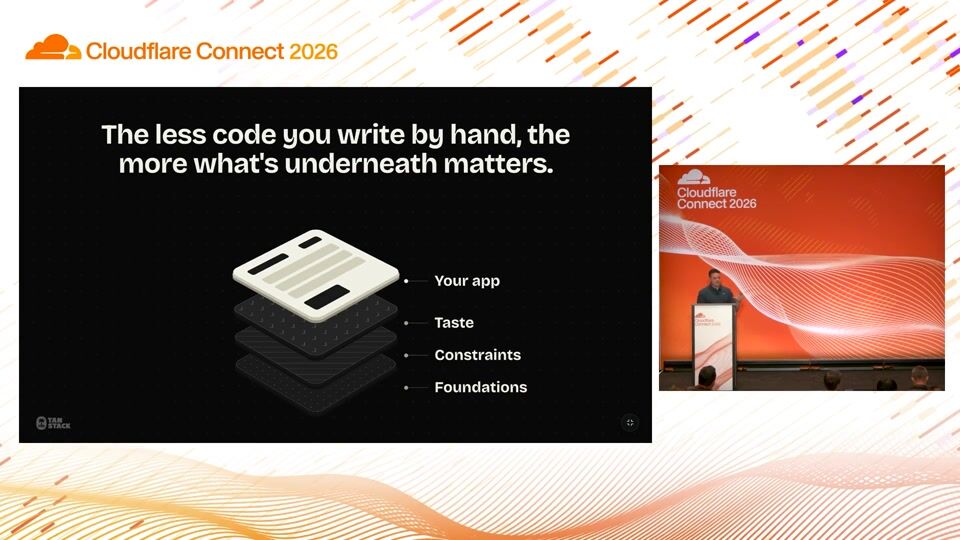
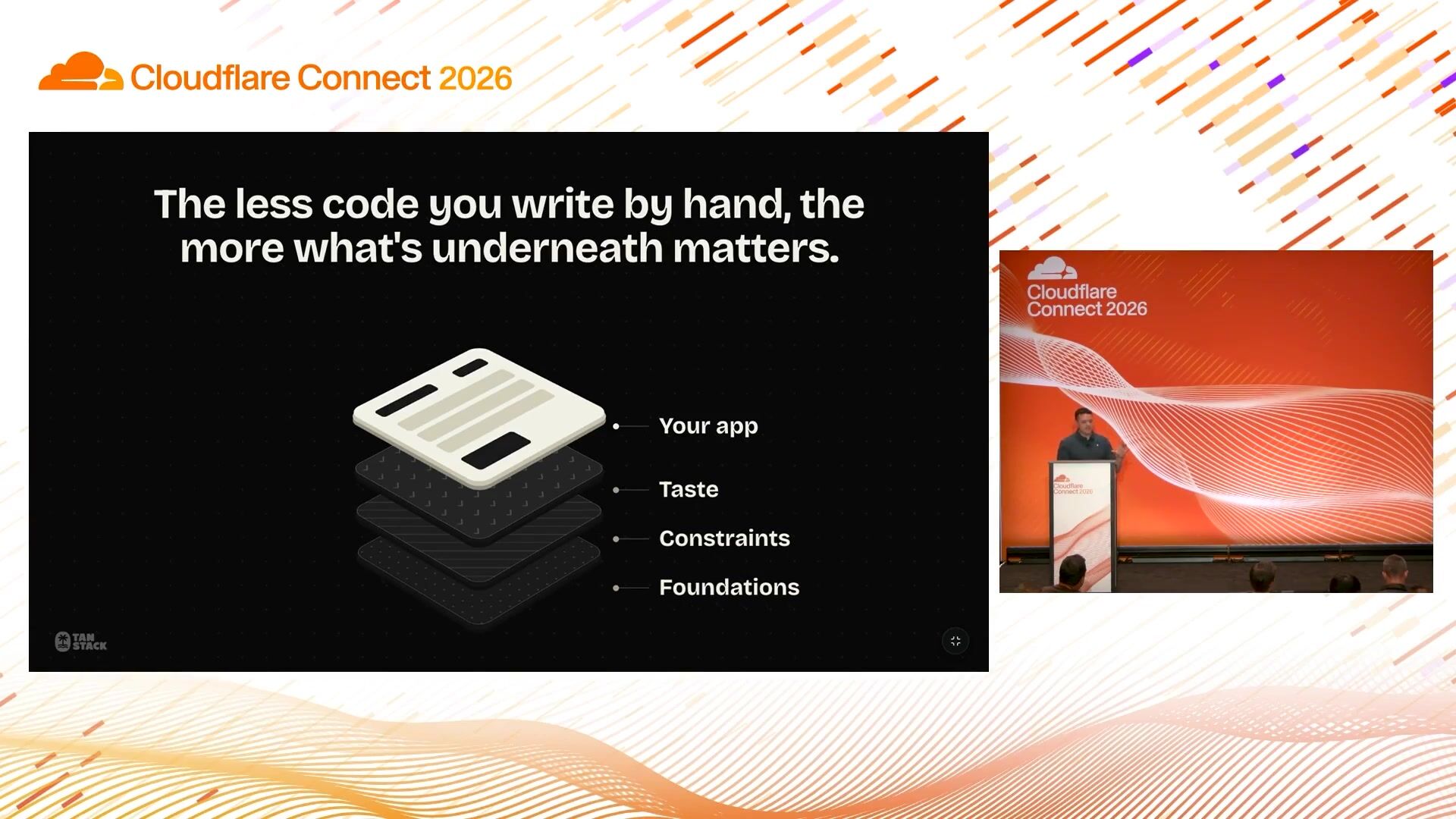
4:24So the less code that we write by hand, the more of what we put underneath that code is very important. We need really good foundations. We need open source. Open source has always given us many, many years of taking all the edge cases, the bugs, the fixes, the community. effort behind making software reliable and giving it back to the masses. And I believe that open source remains the foundation for good software. We need good constraints. We need sensible behavior out of the box, and we need tools that keep us on the rails, type safety, linters, compilers. A lot of what you've heard at Cloudflare today is talking about compilers and just how we're trying to make things run faster and safer. I believe there's another layer that everybody likes to talk about This one's a little more ephemeral.
5:11Opinions about what makes software great to use. And I think those opinions are things that we have earned over time. And some of them are difficult to put into words. All of this, obviously, is what your application sits on. But as I was looking at this stack, I realized that we're missing a layer that we didn't have a year and a half ago. And that is your prompt. We're forgetting that these are the instructions you give. your AI about building. And this is the new programming language. That's what it is. The prompt is the new programming language. So what did these instructions that we're now just YOLOing into the prompt, what did those used to be? We cannot forget them. Well, before AI, we had to scour the web. We had to keep up on social media. We had to test everything. There's a new tool.
5:58We've got to try it out. We had to build proofs of concept. We had to figure out which tools were battle hardened, battle tested. We had. to keep up with updates and security. We didn't know exactly what decisions we were going to make that would give us the best outcome. And a lot of research went into this stack, the things that would make you successful building software. So before AI, you would be out of your mind to skip any of this stuff before starting a project. But for better or worse, today AI lets you do that. it's the first time that a that a tool has allowed you to just skip all of that you can take days weeks like months of decisions if you're working on a big enough project and we squeeze them into a single sentence hopefully not a single sentence but you really this probably would produce something pretty impressive so when we skip them we are rolling the dice we're letting ai make decisions for us and i don't like that thought of course we don't want to make every tiny decision anymore.
7:01AI is supposed to help us be more productive and go faster. But making no decisions is reckless. And that's why I'm seeing a pattern emerge, both with experienced developers and even with people who are new to AI. They don't just come to the prompt and say, build me a CRM. They pour their heart out. Every feature, every screen, how everything should work. And I love seeing this. If you've ever been next to some who's like they're architecting right then and there on the fly and it's like a whiteboarding session happening at 10 times the speed it's so cool but one thing i found in common observing a lot of people even people who are not software engineers that have success building software with ai is that hidden inside of a lot of these instructions are some magic words things like use cloudflare or something like use VEAT, or hopefully, use TANSTOCK.
8:01It's just a couple of words now. Can they really make that big of a difference? Well, each one of these words carries years of hard-earned experience, opinions, software, infrastructure choices. It contains the ideas from talented engineers that have spent decades honing their craft, and users who have run into problems and issues and collect... put that work back into this software to give you a refined product and experience. Every word in your prompt carries more weight now than you can imagine. And it's a little silly, but building a great product can sometimes come down to picking the right tool. That has not changed. It was that way before AI, and I believe it will still be that way going forward.
8:48It's easier than ever to leave these tools out or just get them wrong, and it's really frustrating to watch people. who have the imagination and the capacity to dream up something new, but struggle because they forgot to include a few magic words, or they just don't know that they should. I want to show you what I mean. I want to start with something that everybody wants to build, a website. Build me a website. So you'll probably get an HTML page, which is great, or if you wanted a couple of pages or some interactivity, hopefully your agent gave you something with Veet, that would be And it will look. fantastic, guaranteed. AI is impressive out of the box. But what happens when you need Google to crawl your website, or you need it to work with AI or bots, or you need to do something on the server, or you just need to deploy it and launch it?
9:33Like you say, I'm done, let's get it out there. How do you know that any of that's going to work or that it's production ready? So AI can absolutely help you fix every one of these things. You can definitely go this route, and I think this is what a lot of people who are inexperienced building with AI do. But you or your users will end up fixing many of these things, one at a time, maybe even after you've launched. And every single one is another loop of prompting and reviewing and shipping, and it adds up. in tokens, money, and especially your attention. Attention is the new currency. It's not just about the time it takes to tell your agent, oh yeah, go fix it.
10:21It's the distraction from taking you away from building what actually matters to your users. We don't need that. So I wanna rewind. Build me a website, but use Tanstack Start. Give your site a solid foundation so many of these problems just get solved. Now, if I gave this talk a year ago, I would have had to walk you through all of that. The fine grain detail. installing, building routes, loaders, server functions, middleware, search paramp schemas, isomorphic code, server versus client. I've done that talk a lot of times. I would have literally had to just spew this type of stuff at you for 20 minutes, a lot of it. And it's almost hard to believe that that's what we were doing a year ago now. It's come so far now that I really don't think we need to do that anymore.
11:13I'm so confident that you can just literally tell your agent, use TANSTAC Start. I'm happy to say that for the first time on S stage, after three years of building a router and another three years of building TANSTAC Start, it's finally 1.0. We went stable a week ago. And, thank you.
11:35And luckily there've been a lot of people who have trusted us along that long path to getting to 1.0. If you caught the main stage today, Lovable was showing off how they build millions and millions of Tansac Start applications every day hosted on Cloudflare. It's super humbling. So over the course of its development, we wrote almost 2 million lines of code for Tansac Start since 2022. And it's just tons of commits and pull requests and issues. And obviously, it's a lot of code. But it's not just about the code. It's what it means. it's about all the tests and the edge cases and the things that you just, you don't want to rediscover these problems. And you don't want your users to find them three months after you've launched or a few hours after you just threw your launch party.
12:27It's things like type checking and the end-to-end tests and even the handcrafted skills that we, the creators of these libraries, have built to teach your... agents how to use it correctly. And I believe that that is where trust is built. So obviously TANSEC Start is fast. It's performant. It's type safe. It's built for agents. It's free. All you have to do is ask for it. And if you're already using other tools, moving to TANSEC Start is simpler than ever. You just say, use TANSEC Start or migrate to TANSEC Start. I did this just the other day with a web. site of my good friend, Kent, who's sitting in the front row right here. It took 24 hours. It was a million and a half lines of code and it just worked. And we were able to continue on the path of building the product with a better foundation that all these things that we would have had to worry about were now gone. So start is just the tip of the iceberg.
13:23There are many other things that you don't want your agent reinventing. URL state. data synchronization, AI features, data grids, charts, forms, performance at scale. You really do not want to roll the dice on these things, I promise you. I want to show you a few of them just to illustrate the potential pain that your users might experience. URL state, for example, you do not want your users losing their place as they move around your website. They will leave, I promise. Here's a product catalog with some filters. We'll say like 2,000 products, so we'll filter two in stock, then we'll go to under $50, and then we'll be like, oh, yeah, I like that trail bottle.
14:10You open the bottle, you're like, never mind, there's not an image. I don't want this product. You hit the back button, and all your filters are gone. This has definitely happened to many people here, and I guarantee the amount of times it's happened has gone up since AI, because AI is not very good at managing these sides However, let's rewind. Let's tell it to use Tanistak Router, same app, same interactions, in stock, under 50. You notice something happening in the URL. We open the bottle, and when we go back, we get exactly what we had. And that's because Tanistak Router's packed with all the stuff that you don't want to have to think about. if this person takes that URL and shares it with their friend, are they actually going to see the exact products that you saw?
14:58example is data synchronization. Build me an issue tracker. You obviously do not want stale data in an issue tracker. You don't want different screens showing different data, and you definitely don't want spinners on every page, and you don't want to waste work. You want to cache as many things as you can. Well, that's why we built TanStack Query. It's all handled for you. It's the industry standard for data synchronization, and all you have to do now is just ask for it. Use Tanstack Query, it's literally all you have to do. This one especially, because there's even so much training data on it. Let's do another one. Build me an Ops dashboard for all of our orders, customers and inventory, everything. This is gonna be a huge heavy handed real-time dashboard probably.
15:44Hundreds of thousands of related records feeding into a bunch of widgets and views. So the YOLO version on the left, and Tanstack DB on the right, you're gonna want to use. is the one on the right. TanstackDB comes with all the stuff, the framework for making updates to all this relational data instant, sub-millisecond updates across your app. It's literally a database in your browser. Build me a support agent. That's carrying a lot of weight, that little prompt right there. That could mean building harnesses, agents, chat. functionality, durability, you have to worry about performance and tool calls and debugging and picking providers and managing LLM models. Holy cow, this is Pandora's box.
16:36Let's use Tanstack AI. And all of the hard parts of building AI apps are handled for you. Your agent is now an expert in anything to do with building AI. Data manipulation. Build me a data grid. same thing. You do not want to reinvent these problems for yourself. Just let your agent be an expert in data grids. Charting, same story. I don't want to harp on this too much, but it's all the problems that we've solved. That's why open source is going to remain so important for this industry is because it's literally the time capsule of all of software engineering that we don't want to reinvent these problems forms yeah i i just i could go on for a long time forms a simple form you'd think a form would be easy but there's so much that goes into having a form that works well avoiding race conditions and doing validations and don't get me started on agents using forms agents use forms like a crazy computer does they will break your forms and they're really really good so all this boils down um to we just gotta go past all this there's so much cool stuff in here we have so many cool libraries that we've built um really all of it comes down to just having a good foundation with guardrails and taste uh and it's not just for
18:07tan stack we've even built uh packages that will help other libraries distribute their knowledge to agents can stack intent is a really cool library that don't don't download skills manually make your packages that you install give you the skills naturally 10 second tent is a tool to do that so one minute left uh i just i want to be i i wanted to be real with you and just say that i think ai is amazing um it lets us build things faster than we ever could before but it also makes us build really crappy things faster than ever. And I think that it's a common misconception that to build something amazing, even with AI, you've got to put in a lot of effort. A little bit of effort in the right direction goes a long way.
18:56And I'm glad that I don't have to stand here and teach you and show you code and explain all the intricacies of API design and talk about React Server components again. I'm really glad that I don't have to do any of that anymore. We're lucky enough that today, make no mistakes is starting to become a reality. And using Tanstack is a small thing that you can do today to get you on that path. Thank you.
Alexander Braunreuther, Mark Dembo
Contentful · Cloudflare
Chris Yates
Pantheon
Joe Dixon
Laravel
Be the first to know when registration opens and the agenda goes live.
---
title: "TanStack Start, and the rest of the TanStack ecosystem"
url: "https://www.cloudflare.com/connect/2026/session/tanstack-start-and-the-rest-of-the-tanstack-ecosystem"
year: 2026
---

# TanStack Start, and the rest of the TanStack ecosystem

[Watch session](https://www.cloudflare.com/connect/2026/session/tanstack-start-and-the-rest-of-the-tanstack-ecosystem)

## Session details

- **Track:** Web Performance & Frameworks
- **Topics:** App modernization, Performance & resiliency, Programmable Platforms
- **Solution areas:** Developer Platform

## About this session

TanStack Start is a full-stack framework for React and friends, sitting on top of the rest of TanStack: Query, Router, Table, Form, DB, and more. This session is a tour of Start and the ecosystem around it: how the pieces fit, what it feels like to build with them, and where the stack is headed.

## Speakers

- [Tanner Linsley](https://www.cloudflare.com/connect/speakers/2490275) — Founder, TanStack

## Transcript

[0:02] My name is Tanner Linsley and I'm excited to be here. I'm excited to be able to speak about Tanstack. I've been doing open source for about 10 years and the last three of those have been full -time on Tanstack, which is a really big privilege to be able to do open source full -time. I think it's become very rare and I'm trying to make the best of that. So that started with React's table and then React Query and then things got really out of hand. So now we have over 18 libraries and some of them you probably recognize and there might be some that you don't. Hopefully you're familiar with more of them by the end of today. So Tanstack is way more than just me. It is 40 maintainers about and honestly these people are the reason that Tanstack is such a wonderful community and ecosystem. We are 100 % independent, fully open source.

[0:56] MIT, and we're backed by a lot of really cool partners, Cloudflare being one of them. And it's very likely that you are already using Tanstack. This week, we hit 210 million NPM downloads, right up there with React and Vite. It's still growing like crazy, too. That's seven times more than where it was last year. And AI, obviously, has a lot to do with that. So, recently... Hopefully, you've probably typed something like this into a prompt. And if you haven't, you definitely should. Or maybe it was for a dashboard or a checkout page or something crazy like rebuild my entire CRM for my business. But whatever it was, at some point, maybe in the past or even today, jokingly, you may have added, make no mistakes.

[1:48] I know this has become a bit of a meme for a lot of us. AI absolutely makes mistakes, and that's why it's funny. But I like when I encounter this, make no mistakes, because I think that there's a lot more truth behind it than we give credit for. AI is not a toy anymore. We are running entire businesses on it, building new products every day, and relying on it for things that I never thought we would. It matters more than ever that it doesn't make any mistakes. And I think that's really... what all of us are working towards. Because as code gets infinitely cheaper, I believe that trust is getting more and more expensive, especially when you lose it. So if your users are constantly asking, where did my draft go or why is this slow?

[2:38] Or I click this button and nothing happened. Why did my agent buy this thing twice? Hopefully not that. Like every single hiccup and paper cut that you experience, um, post AI is, is going to cost you in trust. And so when anyone in the world can now ship software and build anything they want, attention to details like these is, it's not just how you stand out, which is what we were worried about before, but it's if you survive at all. So don't get me wrong. Like AI is fan, AI is fantastic at first impressions. I think we're all very convinced of that. Um, one prompt can improve, like produce. results. It can build entire applications. We've seen it do insane things. But users can sense a lack of polish. Users are intuitively smart.

[3:25] Without attention to detail, small problems that come up along the way in the long run can quickly erode user trust. And losing trust because of AI programming and AI development, I believe. now is a bit of an epidemic um there's so many people building software now that couldn't before and many of them are building blind they've never done software before and they're yeah it's just tell ai what to do and move on right we just say just do it and i'll be honest even as a developer i fall into this a lot i'm just like just do it uh so i get it um You shouldn't have to learn every single way that your software can fail before you build something, and not everyone should have to learn how to be a software engineer to build something reliable.

[4:24] So the less code that we write by hand, the more of what we put underneath that code is very important. We need really good foundations. We need open source. Open source has always given us many, many years of taking all the edge cases, the bugs, the fixes, the community. effort behind making software reliable and giving it back to the masses. And I believe that open source remains the foundation for good software. We need good constraints. We need sensible behavior out of the box, and we need tools that keep us on the rails, type safety, linters, compilers. A lot of what you've heard at Cloudflare today is talking about compilers and just how we're trying to make things run faster and safer. I believe there's another layer that everybody likes to talk about This one's a little more ephemeral.

[5:11] Opinions about what makes software great to use. And I think those opinions are things that we have earned over time. And some of them are difficult to put into words. All of this, obviously, is what your application sits on. But as I was looking at this stack, I realized that we're missing a layer that we didn't have a year and a half ago. And that is your prompt. We're forgetting that these are the instructions you give. your AI about building. And this is the new programming language. That's what it is. The prompt is the new programming language. So what did these instructions that we're now just YOLOing into the prompt, what did those used to be? We cannot forget them. Well, before AI, we had to scour the web. We had to keep up on social media. We had to test everything. There's a new tool.

[5:58] We've got to try it out. We had to build proofs of concept. We had to figure out which tools were battle hardened, battle tested. We had. to keep up with updates and security. We didn't know exactly what decisions we were going to make that would give us the best outcome. And a lot of research went into this stack, the things that would make you successful building software. So before AI, you would be out of your mind to skip any of this stuff before starting a project. But for better or worse, today AI lets you do that. it's the first time that a that a tool has allowed you to just skip all of that you can take days weeks like months of decisions if you're working on a big enough project and we squeeze them into a single sentence hopefully not a single sentence but you really this probably would produce something pretty impressive so when we skip them we are rolling the dice we're letting ai make decisions for us and i don't like that thought of course we don't want to make every tiny decision anymore.

[7:01] AI is supposed to help us be more productive and go faster. But making no decisions is reckless. And that's why I'm seeing a pattern emerge, both with experienced developers and even with people who are new to AI. They don't just come to the prompt and say, build me a CRM. They pour their heart out. Every feature, every screen, how everything should work. And I love seeing this. If you've ever been next to some who's like they're architecting right then and there on the fly and it's like a whiteboarding session happening at 10 times the speed it's so cool but one thing i found in common observing a lot of people even people who are not software engineers that have success building software with ai is that hidden inside of a lot of these instructions are some magic words things like use cloudflare or something like use VEAT, or hopefully, use TANSTOCK.

[8:01] It's just a couple of words now. Can they really make that big of a difference? Well, each one of these words carries years of hard-earned experience, opinions, software, infrastructure choices. It contains the ideas from talented engineers that have spent decades honing their craft, and users who have run into problems and issues and collect... put that work back into this software to give you a refined product and experience. Every word in your prompt carries more weight now than you can imagine. And it's a little silly, but building a great product can sometimes come down to picking the right tool. That has not changed. It was that way before AI, and I believe it will still be that way going forward.

[8:48] It's easier than ever to leave these tools out or just get them wrong, and it's really frustrating to watch people. who have the imagination and the capacity to dream up something new, but struggle because they forgot to include a few magic words, or they just don't know that they should. I want to show you what I mean. I want to start with something that everybody wants to build, a website. Build me a website. So you'll probably get an HTML page, which is great, or if you wanted a couple of pages or some interactivity, hopefully your agent gave you something with Veet, that would be And it will look. fantastic, guaranteed. AI is impressive out of the box. But what happens when you need Google to crawl your website, or you need it to work with AI or bots, or you need to do something on the server, or you just need to deploy it and launch it?

[9:33] Like you say, I'm done, let's get it out there. How do you know that any of that's going to work or that it's production ready? So AI can absolutely help you fix every one of these things. You can definitely go this route, and I think this is what a lot of people who are inexperienced building with AI do. But you or your users will end up fixing many of these things, one at a time, maybe even after you've launched. And every single one is another loop of prompting and reviewing and shipping, and it adds up. in tokens, money, and especially your attention. Attention is the new currency. It's not just about the time it takes to tell your agent, oh yeah, go fix it.

[10:21] It's the distraction from taking you away from building what actually matters to your users. We don't need that. So I wanna rewind. Build me a website, but use Tanstack Start. Give your site a solid foundation so many of these problems just get solved. Now, if I gave this talk a year ago, I would have had to walk you through all of that. The fine grain detail. installing, building routes, loaders, server functions, middleware, search paramp schemas, isomorphic code, server versus client. I've done that talk a lot of times. I would have literally had to just spew this type of stuff at you for 20 minutes, a lot of it. And it's almost hard to believe that that's what we were doing a year ago now. It's come so far now that I really don't think we need to do that anymore.

[11:13] I'm so confident that you can just literally tell your agent, use TANSTAC Start. I'm happy to say that for the first time on S stage, after three years of building a router and another three years of building TANSTAC Start, it's finally 1.0. We went stable a week ago. And, thank you.

[11:35] And luckily there've been a lot of people who have trusted us along that long path to getting to 1.0. If you caught the main stage today, Lovable was showing off how they build millions and millions of Tansac Start applications every day hosted on Cloudflare. It's super humbling. So over the course of its development, we wrote almost 2 million lines of code for Tansac Start since 2022. And it's just tons of commits and pull requests and issues. And obviously, it's a lot of code. But it's not just about the code. It's what it means. it's about all the tests and the edge cases and the things that you just, you don't want to rediscover these problems. And you don't want your users to find them three months after you've launched or a few hours after you just threw your launch party.

[12:27] It's things like type checking and the end-to-end tests and even the handcrafted skills that we, the creators of these libraries, have built to teach your... agents how to use it correctly. And I believe that that is where trust is built. So obviously TANSEC Start is fast. It's performant. It's type safe. It's built for agents. It's free. All you have to do is ask for it. And if you're already using other tools, moving to TANSEC Start is simpler than ever. You just say, use TANSEC Start or migrate to TANSEC Start. I did this just the other day with a web. site of my good friend, Kent, who's sitting in the front row right here. It took 24 hours. It was a million and a half lines of code and it just worked. And we were able to continue on the path of building the product with a better foundation that all these things that we would have had to worry about were now gone. So start is just the tip of the iceberg.

[13:23] There are many other things that you don't want your agent reinventing. URL state. data synchronization, AI features, data grids, charts, forms, performance at scale. You really do not want to roll the dice on these things, I promise you. I want to show you a few of them just to illustrate the potential pain that your users might experience. URL state, for example, you do not want your users losing their place as they move around your website. They will leave, I promise. Here's a product catalog with some filters. We'll say like 2,000 products, so we'll filter two in stock, then we'll go to under $50, and then we'll be like, oh, yeah, I like that trail bottle.

[14:10] You open the bottle, you're like, never mind, there's not an image. I don't want this product. You hit the back button, and all your filters are gone. This has definitely happened to many people here, and I guarantee the amount of times it's happened has gone up since AI, because AI is not very good at managing these sides However, let's rewind. Let's tell it to use Tanistak Router, same app, same interactions, in stock, under 50. You notice something happening in the URL. We open the bottle, and when we go back, we get exactly what we had. And that's because Tanistak Router's packed with all the stuff that you don't want to have to think about. if this person takes that URL and shares it with their friend, are they actually going to see the exact products that you saw?

[14:58] example is data synchronization. Build me an issue tracker. You obviously do not want stale data in an issue tracker. You don't want different screens showing different data, and you definitely don't want spinners on every page, and you don't want to waste work. You want to cache as many things as you can. Well, that's why we built TanStack Query. It's all handled for you. It's the industry standard for data synchronization, and all you have to do now is just ask for it. Use Tanstack Query, it's literally all you have to do. This one especially, because there's even so much training data on it. Let's do another one. Build me an Ops dashboard for all of our orders, customers and inventory, everything. This is gonna be a huge heavy handed real-time dashboard probably.

[15:44] Hundreds of thousands of related records feeding into a bunch of widgets and views. So the YOLO version on the left, and Tanstack DB on the right, you're gonna want to use. is the one on the right. TanstackDB comes with all the stuff, the framework for making updates to all this relational data instant, sub-millisecond updates across your app. It's literally a database in your browser. Build me a support agent. That's carrying a lot of weight, that little prompt right there. That could mean building harnesses, agents, chat. functionality, durability, you have to worry about performance and tool calls and debugging and picking providers and managing LLM models. Holy cow, this is Pandora's box.

[16:36] Let's use Tanstack AI. And all of the hard parts of building AI apps are handled for you. Your agent is now an expert in anything to do with building AI. Data manipulation. Build me a data grid. same thing. You do not want to reinvent these problems for yourself. Just let your agent be an expert in data grids. Charting, same story. I don't want to harp on this too much, but it's all the problems that we've solved. That's why open source is going to remain so important for this industry is because it's literally the time capsule of all of software engineering that we don't want to reinvent these problems forms yeah i i just i could go on for a long time forms a simple form you'd think a form would be easy but there's so much that goes into having a form that works well avoiding race conditions and doing validations and don't get me started on agents using forms agents use forms like a crazy computer does they will break your forms and they're really really good so all this boils down um to we just gotta go past all this there's so much cool stuff in here we have so many cool libraries that we've built um really all of it comes down to just having a good foundation with guardrails and taste uh and it's not just for

[18:07] tan stack we've even built uh packages that will help other libraries distribute their knowledge to agents can stack intent is a really cool library that don't don't download skills manually make your packages that you install give you the skills naturally 10 second tent is a tool to do that so one minute left uh i just i want to be i i wanted to be real with you and just say that i think ai is amazing um it lets us build things faster than we ever could before but it also makes us build really crappy things faster than ever. And I think that it's a common misconception that to build something amazing, even with AI, you've got to put in a lot of effort. A little bit of effort in the right direction goes a long way.

[18:56] And I'm glad that I don't have to stand here and teach you and show you code and explain all the intricacies of API design and talk about React Server components again. I'm really glad that I don't have to do any of that anymore. We're lucky enough that today, make no mistakes is starting to become a reality. And using Tanstack is a small thing that you can do today to get you on that path. Thank you.

## Related sessions

- [100 billion profiles, one early bet on Cloudflare Durable Objects](https://www.cloudflare.com/connect/2026/session/100-billion-profiles-one-early-bet-on-cloudflare-durable-objects)
- [Building P1 on Cloudflare: AI-native web composition and governance](https://www.cloudflare.com/connect/2026/session/building-p1-on-cloudflare-ai-native-web-composition-and-governance)
- [Into the tunnel: Secure, metadata-driven routing at scale](https://www.cloudflare.com/connect/2026/session/into-the-tunnel-secure-metadata-driven-routing-at-scale)

## More from Connect

- [All sessions](https://www.cloudflare.com/connect/)
- [Get notified for Connect 2027](https://www.cloudflare.com/connect#2027)

